At the Falls of the Ohio, the limestone ‘pavement’ reveals an abundance of marine fossils—especially in low water. No doubt they caught the interest of Lewis, but his pen appears to be silent. Thomas Rodney sees giant “worms” and in 1819, naturalist Thomas Nuttall sees rugose corals and brachiopods.
A “Flat Pavement”
‘Indiana’ Channel
Falls of the Ohio
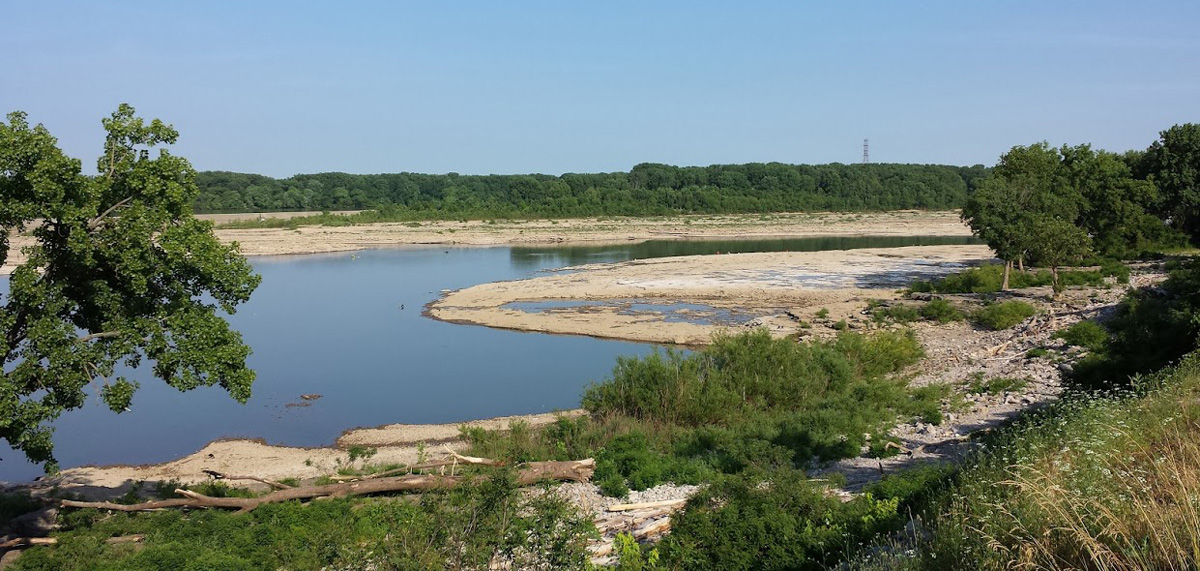
Permission from Censusdata via the Creative Commons Attribution-Share Alike 4.0 International license.
On the Kentucky shore quite to the middle channel the rock is all a flat pavement down to and round the island. The channel on the Kentucky shore however is now dry and the water all decends on that side of the island next the NW shore.
—Thomas Rodney, 16 October 1803[1]Dwight L. Smith and Ray Swick, ed., A Journey Through the West: Thomas Rodney’s 1803 Journal from Delaware to the Mississippi Territory (Athens: Ohio University Press, 1997), 123.
More a series of rapids than a waterfall, the Falls of the Ohio was created by the Ohio River eroding the hard limestone rock of the 386-million-old rocks called Jeffersonville Limestone. This also created a natural crossing point for bison and Native Americans. Modern engineering now diverts the river to the Kentucky side of the falls and the “flat pavement” is now exposed on the Indiana side.
Abundant Petrifications
Crinoids
Upper Fossil Beds, Falls of the Ohio
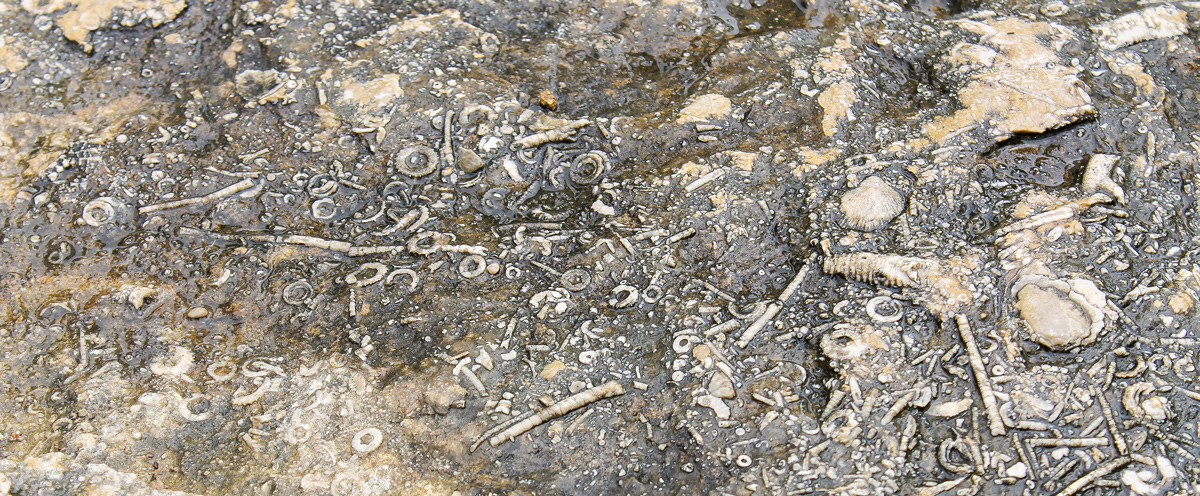
Courtesy Alan Goldstein of the Falls of the Ohio State Park.
In 1805, while Lewis and Clark were crossing the continent, Josiah Espy recorded his observations of the fossils:
The beach and whole bed of the river for two or three miles here is one continued body of limestone and petrifactions. The infinite variety of the latter are equally elegant and astonishing. All kinds of roots, flowers, shells, bones, buffalo horns, buffalo dung, yellow-jacket’s nests, etc., are promiscuously seen in every direction on the extensive beach at low water, in perfect form.
—Josiah Epsy (1805)[2]Josiah Epsy, Memorandums of a Tour Made by Josiah Epsy in the States of Ohio and Kentucky and Indiana Territory in 1805 (Cincinnati: Robert Clarke & Co., 1870), 14
The fossils are actually corals, gastropods (snails), and other shelled animals, called brachiopods and bryozoan.[3]Falls of the Ohio National Wildlife Conservation Area (https://en.wikipedia.org/wiki/Falls_of_the_Ohio_National_Wildlife_Conservation_Area) accessed on 13 January 2019.
Thomas Nuttall’s Observation
In 1819, Thomas Nuttall—one of the most adventurous of the early naturalists on the American frontier—visited the fossil beds:
The calcareous ledge over which the water thus pours is nearly as horizontal as a floor, and are filled with reliquiae of terebratulites [brachiopods], caryophillites [rugose corals], corallines [coralline algae or bryozoans], encrinites [crinoid fragments], &c. It also contains an unusual portion of pyrites, illinitions of blende ore of zinc [traces of sphalerite—the principal zinc sulfide ore], and a bluish green pulverulent substance [powdery mineral], which is perhaps an ore of copper, or an oxide of nickel.[4]Thomas Nuttall, A Journal of Travels into the Arkansa Territory during the year 1819 . . . in Reuben G. Thwaites, Early Western Travels 1748-1846 (Cleveland: The Arthur H. Clark Company, 1905), … Continue reading
Rodney’s ‘Rock Worms’
Large Rugose Coral
Siphonophrentis gigantea
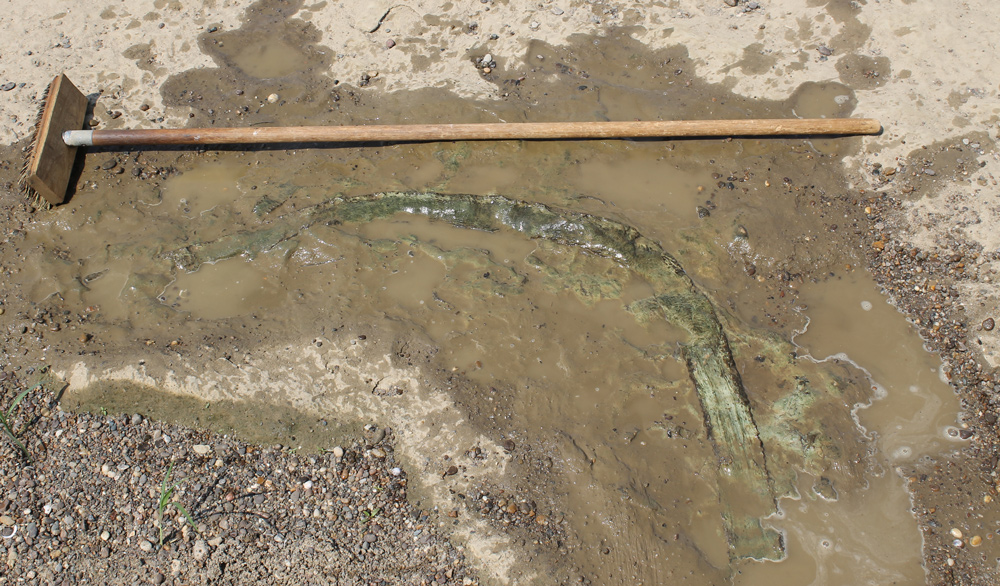
Courtesy Alan Goldstein of the Falls of the Ohio State Park.
The above rugose coral is one of the longest known specimens—four feet!
Whatever Lewis’s impressions of the fossils were, we have no existing record of them. Rodney, less trained than Meriwether Lewis and Thomas Nuttall, recorded this interpretation:
[O]bserved the rock worm, which are kind of stoney and shelly substance in the form of large worms that grow in the rocks that forms the falls, of various [size], from 4 to ten inches long and some two inches diameter, the rock being sothe [softer] than the worms washes away and leaves part of them exposed . . . .
—Thomas Rodney, 16 October 1803[5]Thomas Rodney, Journal, 121–22.
These fossils may have been a topic of conversation when Lewis and Clark shared wine with Rodney on his boat yesterday.
Experience the Lewis and Clark Trail
The Lewis and Clark Trail Experience—our sister site at lewisandclark.travel—connects the world to people and places on the Lewis and Clark Trail.
Plan a trip related to October 18, 1803:
Notes
| ↑1 | Dwight L. Smith and Ray Swick, ed., A Journey Through the West: Thomas Rodney’s 1803 Journal from Delaware to the Mississippi Territory (Athens: Ohio University Press, 1997), 123. |
|---|---|
| ↑2 | Josiah Epsy, Memorandums of a Tour Made by Josiah Epsy in the States of Ohio and Kentucky and Indiana Territory in 1805 (Cincinnati: Robert Clarke & Co., 1870), 14 |
| ↑3 | Falls of the Ohio National Wildlife Conservation Area (https://en.wikipedia.org/wiki/Falls_of_the_Ohio_National_Wildlife_Conservation_Area) accessed on 13 January 2019. |
| ↑4 | Thomas Nuttall, A Journal of Travels into the Arkansa Territory during the year 1819 . . . in Reuben G. Thwaites, Early Western Travels 1748-1846 (Cleveland: The Arthur H. Clark Company, 1905), 13:66–67 available at www.archive.org/details/nuttallsjournalo00nuttrich. |
| ↑5 | Thomas Rodney, Journal, 121–22. |