Slo-ce-ac-cum (Palouse Indian, 1847)
Paul Kane (1810–1871)
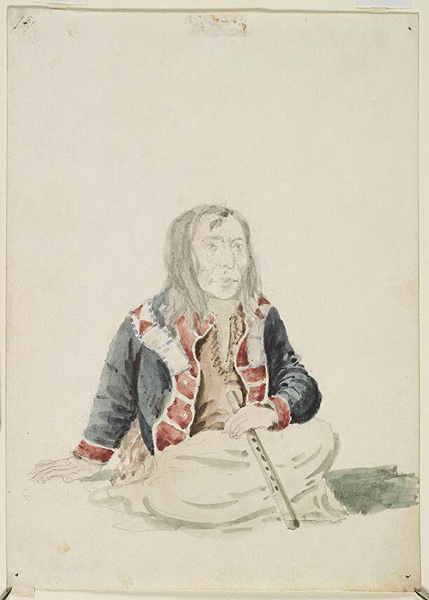
Watercolour and graphite on paper, 18.0 x 13.0 cm. Courtesy Royal Ontario Museum, https://rom.on.ca.
At the time of the Lewis and Clark Expedition, the Palouse Indians had coalesced around four primary villages on the lower Snake River: Wawaiwai, Almota, Penewawa, and Palus. Lewis and Clark estimated their population as 2,300 which included Northern Nez Perce.[1]Moulton, Journals, “Estimate of Western Indians,” 6:474.
About Slo-ce-ac-sum (see Figure), the Paul Kane wrote:
We swam our horses at the mouth of the Pelouse River, where it empties itself into the Nezperees [Snake River]. The Chief of this place is named Slo-ce-ac-cum. He wore his hair divided in long masses, stuck together with grease.[2]Paul Kane, Wanderings of an Artist among the Indians of North America . . . (London: Longman, Brown, Green, Longmans, and Roberts, 1859), 274.
Selected Encounters
October 11, 1805
Down the Snake River
by Kristopher K. Townsend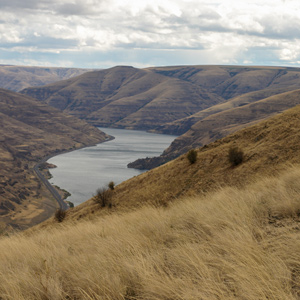
Between present Clarkston and Almota, Washington, the paddlers navigate numerous Snake River rapids where the Nez Perce and Palouse have established fisheries. The captains buy salmon and dogs and notice a curious sweat lodge.
In Santa Fe, governor Real Alencaster recommends that a military force stop the Lewis and Clark Expedition.
October 12, 1805
Snake River rapids
by Kristopher K. Townsend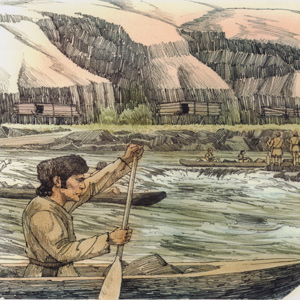
Now on the Snake River, the paddlers make about thirty miles before stopping at a long rapid at present Riparia, Washington. Sgt. Gass describes Palouse villages, and they have difficulty finding firewood.
October 13, 1805
Fast water
by Kristopher K. Townsend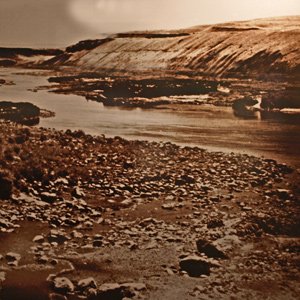
To start the day, the non-swimmers portage rifles and scientific equipment while the boatmen navigate a long Snake River rapid. Late in the day above the present Palouse River, they run a two-mile rapid which “ran like a mill race.” Clark finds that Sacagawea “reconsiles all the Indians, as to our friendly intentions”.
In Santa Fe, a Spanish governor Joquin Alencaster gives instructions to prevent the Lewis and Clark Expedition from returning.
October 14, 1805
'Ship Rock'
by Kristopher K. Townsend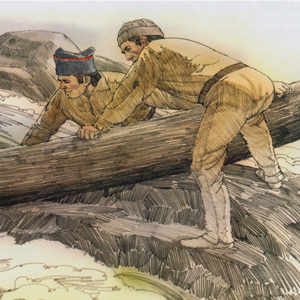
After passing a ‘ ship rock‘—Monumental Rock on the Snake River in Washington—Sgt. Ordway‘s canoe gets stuck on a rock and fills with water. They stop for the day and begin drying wet items.
In Santa Fe, Pedro Vial leaves with orders to prevent the Lewis and Clark Expedition from succeeding.
October 15, 1805
Snake River rapids
by Kristopher K. Townsend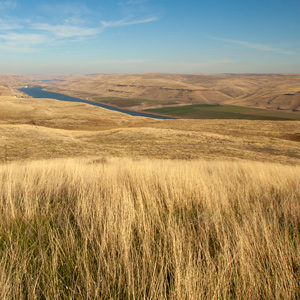
The first half of the day is spent drying items while the hunters and Lewis explore the high plains above the Snake River. Some items must be packed up wet so that they can continue down the river. They pass through several difficult rapids and camp above present Fishhook Rapids.
October 16, 1805
A musical welcome
by Kristopher K. Townsend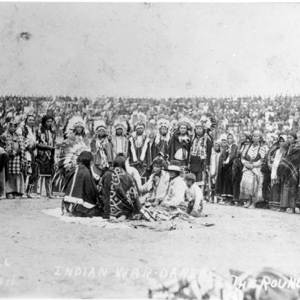
The paddlers negotiate the last of the Snake River rapids and the expedition arrives at the Columbia River. Soon after, they are given a musical welcome from a large group of Yakamas and Wanapums. The captains give them tobacco, peace medals, and other gifts.
October 17, 1805
Snake and Columbia observations
by Kristopher K. Townsend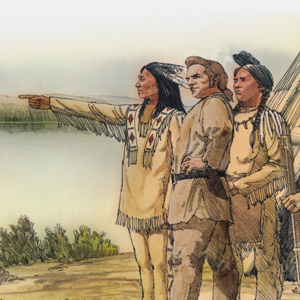
On this clear morning at the confluence of the Columbia and Snake rivers, the captains take lunar observations. Later, Clark is escorted about ten miles up the Columbia where he notes Native ways and salmon ecology. Lewis takes Wanapum and Yakama vocabularies, and hunters are sent out to collect sage grouse specimens.
October 18, 1805
Down the Columbia
by Kristopher K. Townsend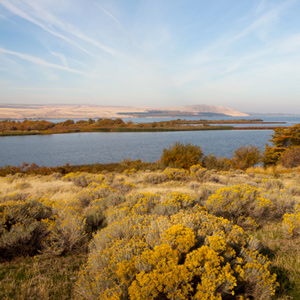
The captains council with the Wanapums and Yakamas and record Sahaptian vocabularies. Clark measures the widths of the Snake and Columbia rivers, and they purchase 40 dogs as a store of provisions. Late in the day, the expedition heads down the Columbia and camps below the Twin Sisters in Wallula Gap.
June 8, 1806
Prisoner's base
by Kristopher K. Townsend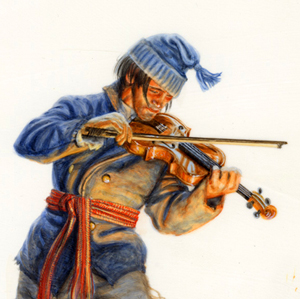
Several Nez Perce people visit Long Camp, and to get the men in shape for their imminent return home, foot races are run, and prisoner’s base is played with their guests. The sunken dugout canoe is raised and three horses traded. The day ends with dancing.
July 4, 1806
Dangerous roads
by Kristopher K. Townsend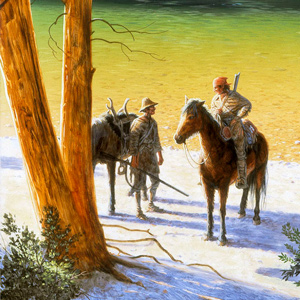
The expedition is divided into two groups, and today, both are on dangerous roads.
On the Blackfoot River, Lewis’s Nez Perce guides warn him about dangerous Indians, and they decline to continue. He travels east on “Cokahlahishkit”—the Road to the Buffalo—for eight miles. He also collects a specimen of mock orange, a species named in his honor.
On the Bitterroot River, Clark’s group must cross several creeks swollen from snows melting in the nearby Bitterroot Mountains. Despite there being no buffalo, whiskey, or tobacco, they celebrate the Fourth of July with a “Sumptious Dinner”.
Notes
Experience the Lewis and Clark Trail
The Lewis and Clark Trail Experience—our sister site at lewisandclark.travel—connects the world to people and places on the Lewis and Clark Trail.
Discover More
- The Lewis and Clark Expedition: Day by Day by Gary E. Moulton (University of Nebraska Press, 2018). The story in prose, 14 May 1804–23 September 1806.
- The Lewis and Clark Journals: An American Epic of Discovery (abridged) by Gary E. Moulton (University of Nebraska Press, 2003). Selected journal excerpts, 14 May 1804–23 September 1806.
- The Lewis and Clark Journals. by Gary E. Moulton (University of Nebraska Press, 1983–2001). The complete story in 13 volumes.
This site is provided as a public service by the
Lewis and Clark Trail Alliance
with additional funding from the following: