Lewis and his flotilla move down the Ohio River above the Falls of the Ohio where William Clark awaits his arrival. On or near this day, Lewis passes the mouth of the Kentucky—a 255-mile-long river flowing northwest through Kentucky.[1]Due to a gap in Lewis’s Ohio River journal, his precise location for this date is unknown.
The Kentucky River
Kentucky River Mouth c. 1908
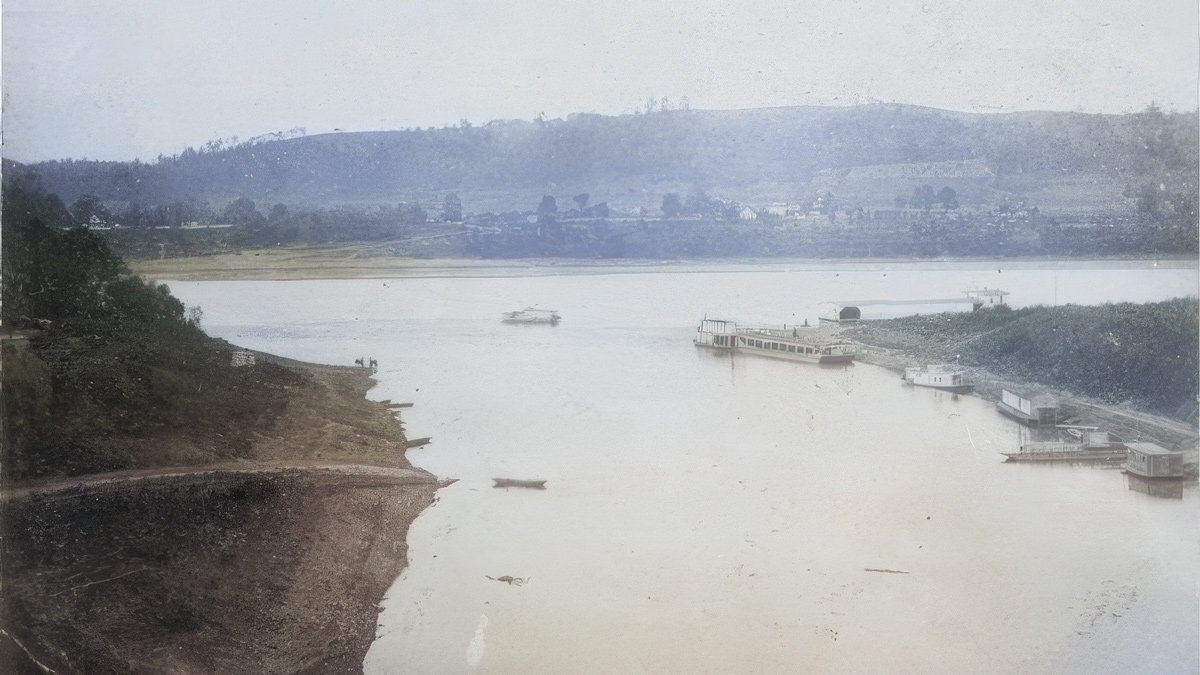
Cropped and colorized. Original courtesy www.nkyviews.com. Used with permission.
We passed the mouth of Kentucky River. This is a large river about the size of the Great Kanawa at [blank] but not so deep as there appears drift wood in it.
There is a pretty little town on the uper side with 6 or 7 brick houses in it and 15 to 20 wooden ones. The situation is pleasant.
—Thomas Rodney, 11 October 1803[2]Dwight L. Smith and Ray Swick, ed., A Journey Through the West: Thomas Rodney’s 1803 Journal from Delaware to the Mississippi Territory (Athens: Ohio University Press, 1997), 115.
Port William is present Carrollton, Kentucky.
Zadok Cramer’s Good Prospect
This river gives name to the state it intersects—flows in innumerable meanderings, through perhaps the most extensive body of good land known to the world. It is navigable for loaded boats, during a considerable part of the year for upwards of 150 miles. There is a town on one side of the mouth, called Williamsport, and another on the other side, both of them small at present, but they have a good prospect of deriving, at a future day, considerable importance from the growing navigation of the Kentucky. [3]Zadok Cramer, The Ohio and Mississippi Navigator: Containing Directions for Navigating the Monongahela, Allegheny, Ohio and Mississippi Rivers . . . (Pittsburgh: Zadok Cramer, Bookseller & … Continue reading
Rapid Fluctuations
The Kentucky and Green rivers empty themselves into the Ohio, after a course of three hundred miles; they fall so low in summer time, that they are forded a hundred and fifty miles from their embouchure; but in the winter and spring they experience such sudden and strong increases that the waters of the Kentucky rise about forty feet in four-and-twenty hours.[5]François André Michaux, Travels to the West of the Alleghany Mountains . . . Undertaken in 1802 ((Cleveland: The Arthur H. Clark Co., 1904), 223, available at … Continue reading
On the Ohio and below the mouth of the Kentucky, Rodney encounters a dangerous rock bar:
The Most Dangerous Part
[W]e passed a stoney bar in the middle of the river but attached to the Kentucky shore by a flat and riffle. We took the channel next the NW shore and not far from the bar to avoid a small stoney bar on that shore. This and the last mentioned are of the most dangerous parts of the river that we have passed.
—Thomas Rodney, 12 October 1803[6]Thomas Rodney, Journal, 115.
Experience the Lewis and Clark Trail
The Lewis and Clark Trail Experience—our sister site at lewisandclark.travel—connects the world to people and places on the Lewis and Clark Trail.
Plan a trip related to October 10, 1803:

Notes
| ↑1 | Due to a gap in Lewis’s Ohio River journal, his precise location for this date is unknown. |
|---|---|
| ↑2 | Dwight L. Smith and Ray Swick, ed., A Journey Through the West: Thomas Rodney’s 1803 Journal from Delaware to the Mississippi Territory (Athens: Ohio University Press, 1997), 115. |
| ↑3 | Zadok Cramer, The Ohio and Mississippi Navigator: Containing Directions for Navigating the Monongahela, Allegheny, Ohio and Mississippi Rivers . . . (Pittsburgh: Zadok Cramer, Bookseller & Stationer, 1802), 35. |
| ↑4 | William E. Ellis, The Kentucky Encyclopedia, John E. Kleber, ed. (University of Kentucky Press, 1992), s.v. “Kentucky River”. |
| ↑5 | François André Michaux, Travels to the West of the Alleghany Mountains . . . Undertaken in 1802 ((Cleveland: The Arthur H. Clark Co., 1904), 223, available at archive.org/details/travelswestofall00thwarich. |
| ↑6 | Thomas Rodney, Journal, 115. |