On or near this date, Meriwether Lewis rejoins the boats, and together they move down the Ohio River below Big Bone Lick. According to Thomas Rodney‘s journal, the hazards of navigating the Ohio in low water continue with numerous islands, sandbars, and riffles.[1]Due to a gap in Lewis’s Ohio River journal, we do not know his exact location on this date. He is certainly ahead of Thomas Rodney who arrived at the Big Bone Lick landing the next day.
Gunpowder Creek and Ohio River
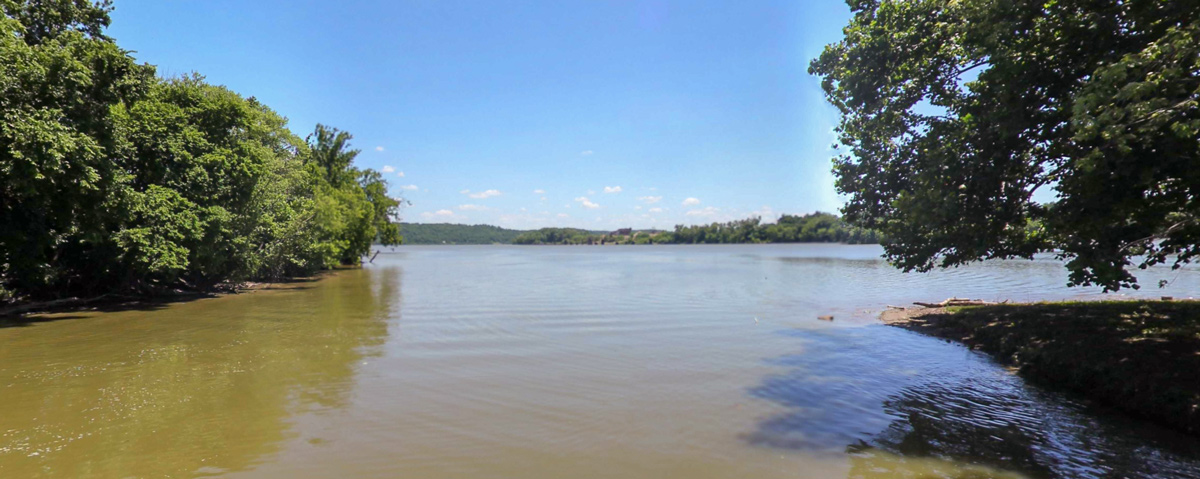
Photo by Ryan Abrahamsen, Terrain 360. Explore the Gunpowder Creek 360º Spherical Image Map at www.terrain360.com/trail/gunpowder-creek.
Gunpowder Creek is just above Landing Creek—the typical access point to Big Bone Lick. The road to the diggings was an old buffalo trace wide enough for two wagons—today’s Kentucky State Highway 338, also known as Beaver Road.
Big Sugar Creek
[We] passed a large creek on the Kentucky shore and a small sand bar and rapid. From this our course through a short reach W by N. At ten o’clock we passed another large creek on Kentucky shore towards the lower end of this reach. There is a rocky bar runs all along the Ky. shore through this reach.
—Thomas Rodney, 11 Oct 1803[2]Dwight L. Smith and Ray Swick, ed., A Journey Through the West: Thomas Rodney’s 1803 Journal from Delaware to the Mississippi Territory (Athens: Ohio University Press, 1997), 114.
Young Island
At ¼ before 12 we passed a large creek on NW shore which falls in just at the uper end of the island bar. Here we took in the Major and Shields who had been walking on shore several miles. At 20 minutes after 12 we past the lower end of this island and the next reach varies to SW again. This is a young island, the land low and the trees but small.
—Thomas Rodney, 11 October 1803[3]Thomas Rodney, Journal, 115.
Moving up the Missouri River 1804, the captains customarily alternated commandeering the boats and walking the shore. One can only speculate that Lewis walked the shore while on the Ohio.
Indian Creek
[W]e passed a riffle at the uper end of a wide sand bar spreading from the Kentucky shore more than 2/3 over the river. The channel is deep but close to the NW shore. This bar is near or quite a mile long and is about 3 miles . . . . [W]e passed a pretty large creek on the NW shore. This is called Indian Creek.
—Thomas Rodney, 11 October 1803[4]Ibid.
Today’s Indian Creek is just downriver from present Vevay, Indiana. The wide sandbar and riffle described were likely at present Bryant Creek.
Experience the Lewis and Clark Trail
The Lewis and Clark Trail Experience—our sister site at lewisandclark.travel—connects the world to people and places on the Lewis and Clark Trail.
Plan a trip related to October 9, 1803:

Notes
| ↑1 | Due to a gap in Lewis’s Ohio River journal, we do not know his exact location on this date. He is certainly ahead of Thomas Rodney who arrived at the Big Bone Lick landing the next day. |
|---|---|
| ↑2 | Dwight L. Smith and Ray Swick, ed., A Journey Through the West: Thomas Rodney’s 1803 Journal from Delaware to the Mississippi Territory (Athens: Ohio University Press, 1997), 114. |
| ↑3 | Thomas Rodney, Journal, 115. |
| ↑4 | Ibid. |