Long before first light, the rains begin and the day is wet and windy. Despite being only a day away from Louisville, Lewis may have had to hunker down in what Thomas Rodney calls “the Indian wilderness”—a 50-mile stretch between Indiana on one shore and Kentucky on the other.
Kentucky Hills below Carrollton
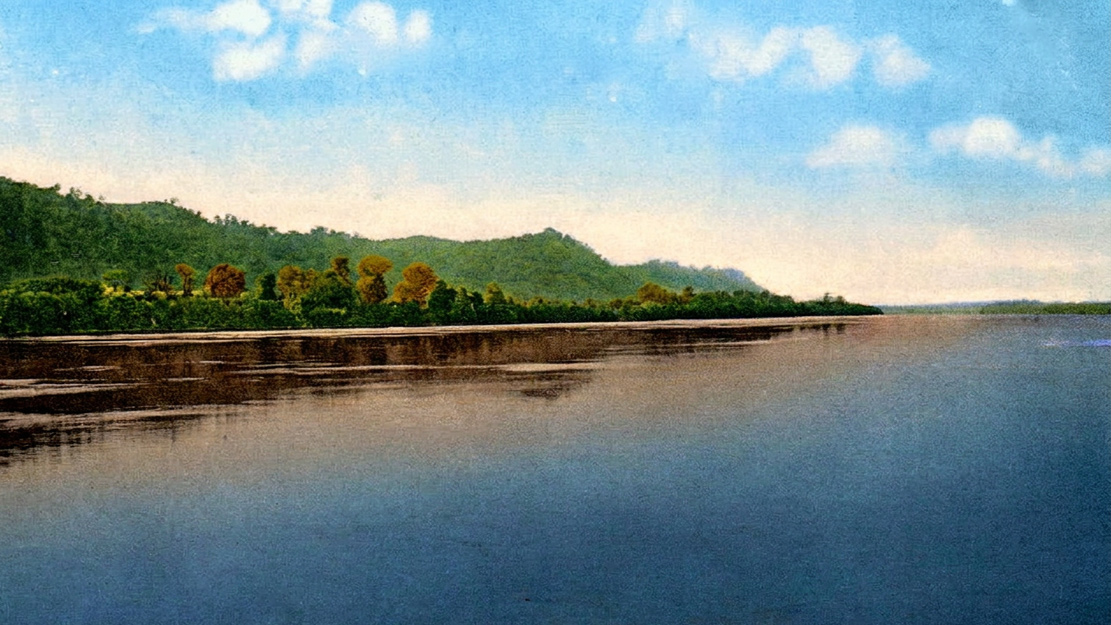
Colorized and repaired. Original provided by www.nkyviews.com. Used with permission.
Furious Winds
For much of the day, the current of the Ohio River was no match for the headwinds that pushed the boats in the opposite direction:
Tho it blowed furiously, we rowed the boat through the reach when the wind slacked and became equinoc[ti]al among broken mountains; and we still proceeded. It has rained hard all day and still continues at 4 o’clock P.M. Our cabin leaked as before; and we could not keep even our beds dry [despite] all we could do; nor could we cook, and have been obliged to use such scraps as we had by us.
—Thomas Rodney, 12 October 1803[1]Dwight L. Smith and Ray Swick, ed., A Journey Through the West: Thomas Rodney’s 1803 Journal from Delaware to the Mississippi Territory (Athens: Ohio University Press, 1997), 117.
The Indian Wilderness
At 1/2 after 6 o’clock we cast ankor under the Kentucky shore. We were lucky in coming to ankor just above a dangerous riffle in the middle of the river, there being no settlement near us. The Indian land is on the NW shore from opposite the mouth of Kentucky River for 49 miles down; and there is but few settlements on the Kentucky side opposite the Indian Land.
—Thomas Rodney, 11 October 1803[2]Thomas Rodney, Journal, 116.
Hunting Turkeys
During the Lewis and Clark Expedition, wind delays were opportunities to hunt. We don’t know if Lewis sent out hunters on this day, but Rodney certainly tried:
In passing along the Indian wilderness we saw two flocks of turkies on the shore. I went on shore with gun above twelve; but they got frightend at the boat and took to the woods and run like Indians so that I could not git near them.
—Thomas Rodney, 12 October 1803[3]Thomas Rodney, Journal, 117.
Drying Out
The rain ceased [in the evening] just after we came to ankor; and we got our dinner and super altogether we went to bed about 8 o’clock in our wet beds; and I slept very sound and well till near 4 o’clock this morning when I got up . . . . My clothes and bed had got dry by my sleeping in them and I felt no injury.
—Thomas Rodney, 13 October 1803[4]Ibid.
Experience the Lewis and Clark Trail
The Lewis and Clark Trail Experience—our sister site at lewisandclark.travel—connects the world to people and places on the Lewis and Clark Trail.
Plan a trip related to October 12, 1803: