About midday, the unloaded barge is piloted through the Falls of the Ohio—a ‘terrible place’ with “dreadful crags dangerous for vessels to touch”. Thomas Rodney goes through three days later and feels a “dread of wrecking”.[1]Thomas Rodney—who arrived at Louisville at 1:00 pm on 15 October—also wrote that “Lewis’s boat passed Falls just before we got here”. Thomas Rodney to Caesar A. Rodney, 16 … Continue reading
Falls of the Ohio
From the sketchbook of Steve Ludeman
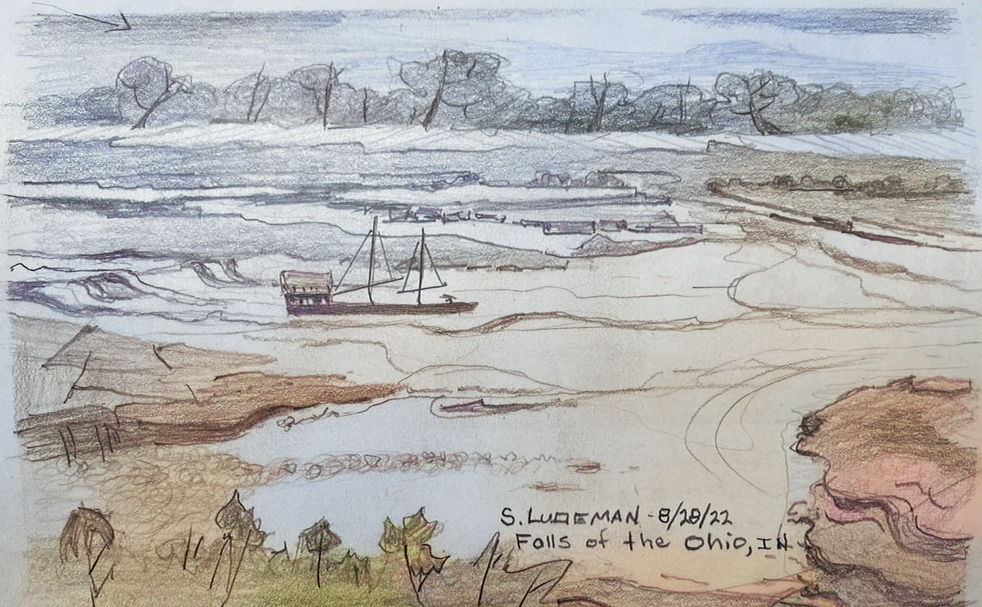
Colorized from a black and white sketch by Steve Ludeman, © 2023 www.steveludemanfineart.com. Used by permission.
A ‘Terrible Place’
The rock that forms the great bed of the Falls is lime stone covered about 2 to 4 inches with a kind of iron stone . . . . [T]he limestone rock lies hard above [its] base about a foot thick and cracks various ways, and being cut to pieces brake of[f] in blocks[s] and great flakes, but are first but into deep holes and sharp and dreadful crags dangerous for vessels to touch . . . . They are a terrable place to pass through when the water is as low as now.
For the first time I had a dread of wrecking our boat. The rocks are so cragy, the channil so crooked, and the water so furious and rapid that it requires the utmost care and dexterity to avoid the danger. There are several islands in the Falls and a large island and several sand bars below and riffles for 2 miles below, so that indeed there is 4 miles of rapid and difficulty . . . .
—Thomas Rodney, 16 and 18 October 1803[2]Dwight L. Smith and Ray Swick, ed., A Journey Through the West: Thomas Rodney’s 1803 Journal from Delaware to the Mississippi Territory (Athens: Ohio University Press, 1997), 122–25, 125.
The Pilots
A pilot, for the safe conducting of boats through those falls, has been regularly appointed by the court, who is answerable for all damages sustained through his neglect of bad management. The prices for pilotage of boats of all sized are regulated by the court. A light boat can pass at all times when directed by a skilful pilot, and if it should be found necessary to unload at Bear grass and reload again below the rapids, the portage is not a very long one, being scarcely two miles. . . . In levelling the descent of the rapids, it has been found to be 22 1/2 feet in two miles.[3]Zadok Cramer, The Ohio and Mississippi Navigator: Containing Directions for Navigating the Monongahela, Allegheny, Ohio and Mississippi Rivers . . . (Pittsburgh: Zadok Cramer, Bookseller & … Continue reading
Pilots were licensed by the county court in Louisville. Starting in late 1803, the Indiana Territory also began licensing pilots. Two possible pilots may have been James Patton, the father-in-law of Pvt. Nathaniel Pryor, and Davis Floyd, the brother of Sgt. Charles Floyd.[4]Indiana Historical Bureau, “Lewis and Clark—Indiana Connections,” The Indiana Historian (2003), 7.
Historian James J. Holmberg brings up the possibility that the expedition’s delay at the Falls of the Ohio may have been caused by the barge needing repairs after today’s descent.[5]Holmberg, “Lewis and Clark at the Falls of the Ohio: A Timeline,” 2.
Rodney’s Portage and Passage
Plan of the Rapids or Falls of the Ohio
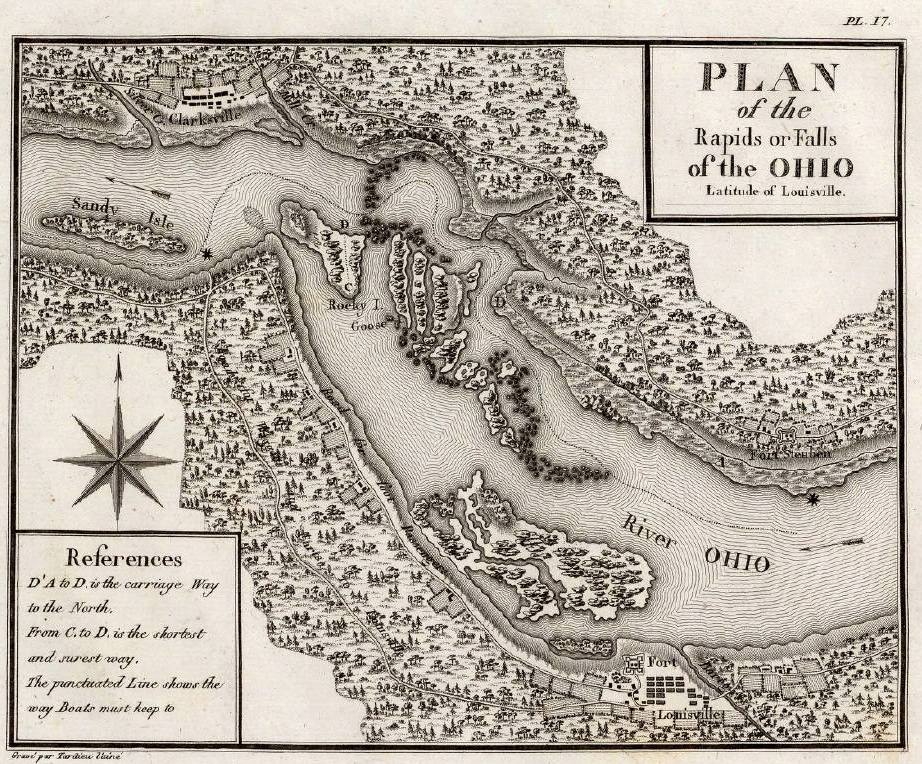
Victor Collot, A Journey in North America (1796), Plate 17.
Above: Collot has drawn both the wagon road and footpath between Louisville and the warf above Sandy Isle. The dotted line is the line the boats must take.
No record of the barge’s passage is known to exist, so Rodney’s description is offered:
Mr. Shields [and] the Major went with the goods and wagon down below the Falls; and I went with the batteau, with the pilot Patton and a steerman and Buckanan, through the Falls. We hung a minute on a rock above the brig and struck twice after but went through safe . . . .
—Thomas Rodney, 18 October 1803[6]Rodney, Journal, 124.
The Falls Today
Falls of the Ohio, Indiana Shore
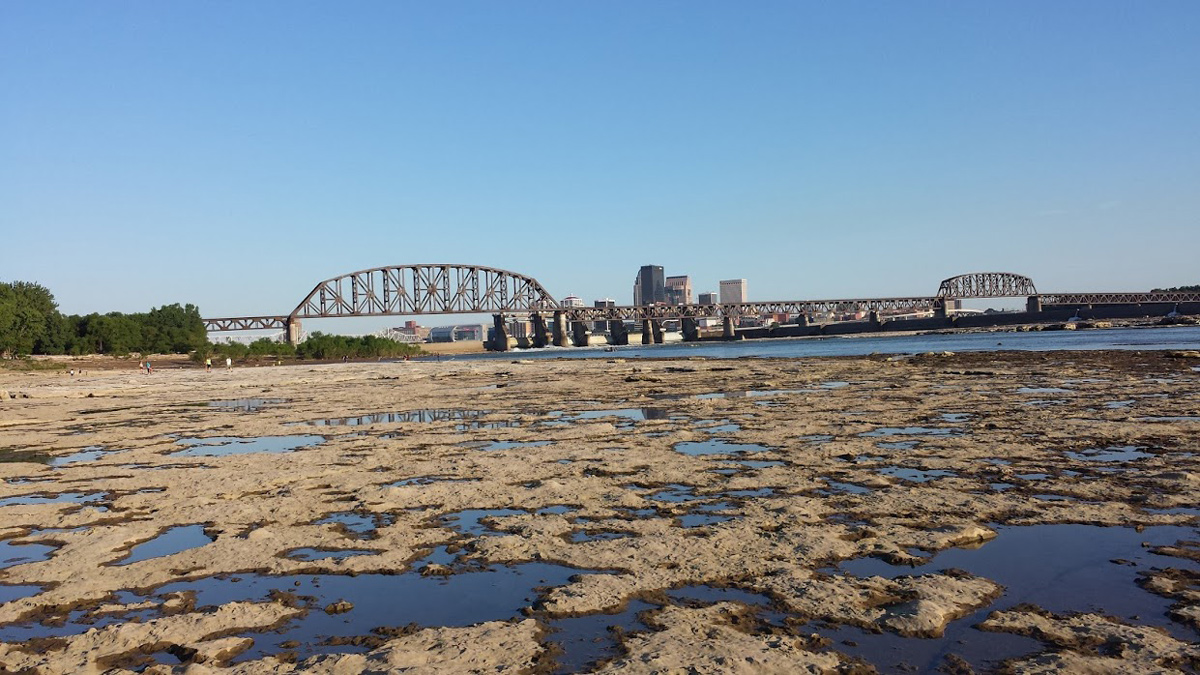
Permission via the Creative Commons Attribution-Share Alike 4.0 International license by Censusdata.
Falls of the Ohio
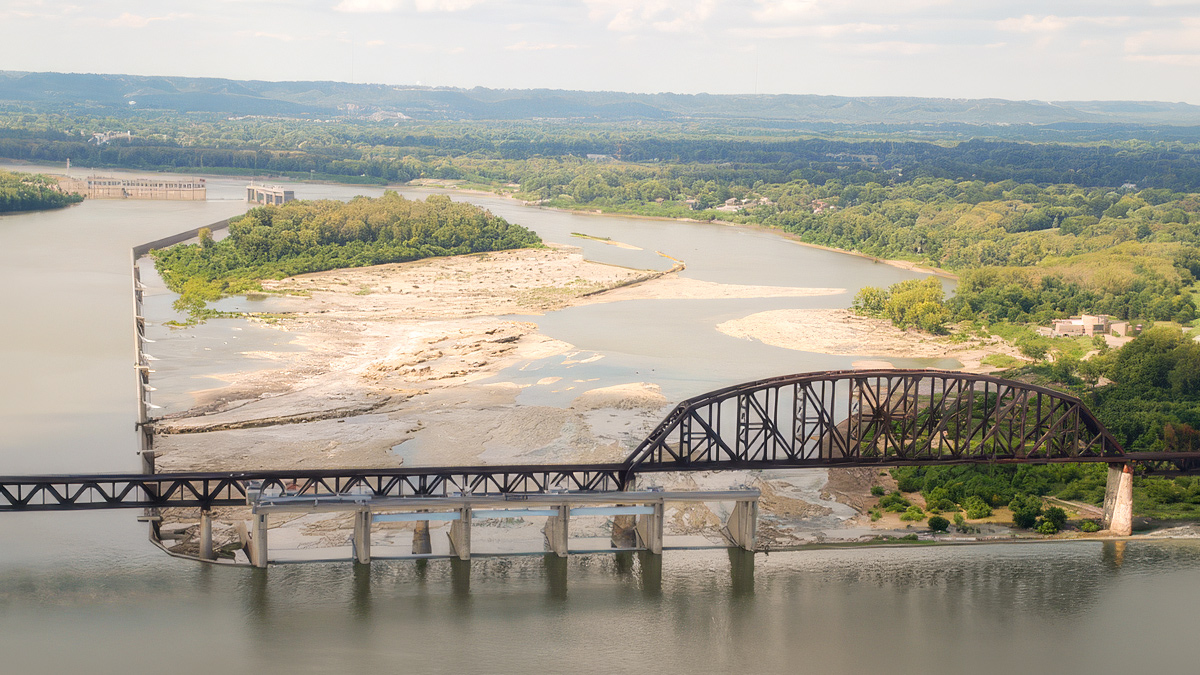
Provided by the U.S. Corps of Engineers.
Today, the dangers of the rapids at Falls of the Ohio are mitigated by the work of the U. S. Army Corps of Engineers. The lower figure shows how the water is diverted from the northern (right) channel so that river traffic can be diverted to the southern (left) channel. Both the above figures show the 14th Street Bridge which has been rebuilt several times since its original 1870 construction. In the lower figure, the George Rogers Clark Homesite is on the Indiana shore opposite the downstream end of the island.
Colter Enlists
In a summary of extra pay awarded the men, Clark recorded Colter’s enlistment:
We the Subscribers do acknowledge to have received of [blank] the several Sums set opposite to our names, the Same being due us from the War department pursuant to an Act of Congress bearing date March 3rd 1807, entitled ‘an Act makeing compensation to Messrs. Lewis & Clark and their companions.
. . . .
Name Period of Service Monthly Rate Amount John Colter 15 Oct. 1803 to 10 Oct. 1806 5 [$]179.33 1/3[7]Donald Jackson citing Yale University Library, New Haven, Connecticut in Letters of the Lewis and Clark Expedition with Related Documents: 1783-1854, 2nd ed. (Urbana: University of Illinois Press, … Continue reading
Experience the Lewis and Clark Trail
The Lewis and Clark Trail Experience—our sister site at lewisandclark.travel—connects the world to people and places on the Lewis and Clark Trail.
Plan a trip related to October 15, 1803:

Notes
| ↑1 | Thomas Rodney—who arrived at Louisville at 1:00 pm on 15 October—also wrote that “Lewis’s boat passed Falls just before we got here”. Thomas Rodney to Caesar A. Rodney, 16 October 1803 in Simon Gratz, “Thomas Rodney,” Pennsylvania Magazine of History and Biography 43, no. 2 (1919), 133, journals.psu.edu/pmhb/article/view/27526 accessed 8 September 2026. |
|---|---|
| ↑2 | Dwight L. Smith and Ray Swick, ed., A Journey Through the West: Thomas Rodney’s 1803 Journal from Delaware to the Mississippi Territory (Athens: Ohio University Press, 1997), 122–25, 125. |
| ↑3 | Zadok Cramer, The Ohio and Mississippi Navigator: Containing Directions for Navigating the Monongahela, Allegheny, Ohio and Mississippi Rivers . . . (Pittsburgh: Zadok Cramer, Bookseller & Stationer, 1802), 36. |
| ↑4 | Indiana Historical Bureau, “Lewis and Clark—Indiana Connections,” The Indiana Historian (2003), 7. |
| ↑5 | Holmberg, “Lewis and Clark at the Falls of the Ohio: A Timeline,” 2. |
| ↑6 | Rodney, Journal, 124. |
| ↑7 | Donald Jackson citing Yale University Library, New Haven, Connecticut in Letters of the Lewis and Clark Expedition with Related Documents: 1783-1854, 2nd ed. (Urbana: University of Illinois Press, 1978), 2:378. |