At the Falls of the Ohio, the captains prepare for departure. On their list of required supplies would be salt. Salt not only made food taste better—at least in the eyes of Meriwether Lewis—but salt was used to keep meat from spoiling. Just a day’s ride away was an important salt producing area built up around Kentucky’s first commercial saltworks, Bullitt’s Lick.
In Washington City, President Jefferson asks the House of Representatives to ratify the Louisiana Purchase treaty.
Salt Brine
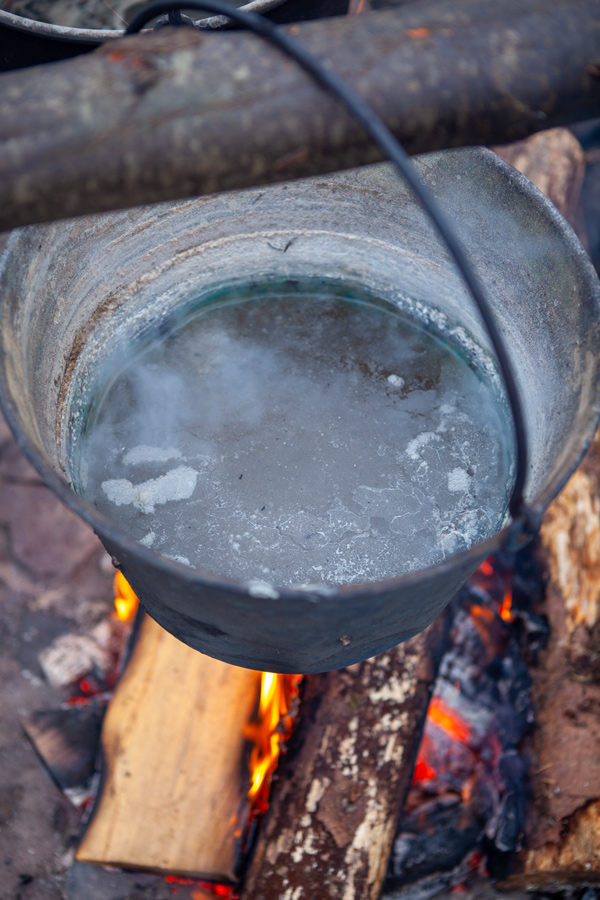
© 2013. Permission to use granted under the Creative Commons Attribution-Share Alike 4.0 International license.
Bullitt’s Lick
Bullitt’s Lick was long considered the most significant source of salt in Kentucky:
Many fine salt springs, whose places appear in the map, constantly emit water which, being manufactured, affords great quantities of fine salt. At present there is but one, called Bullet’s Lick, improved, and this affords salt sufficient for all Kentucke, and exports some to the Illinois.
—John Filson, 1784[1]John Filson, The Discovery, Settlement and Present State of Kentucke (1784): An Online Electronic Text Edition, ed. Paul Royster (Lincoln: University of Nebraska), page 24, … Continue reading
Bullitt’s Saltworks
Nov. 13. Bullets Creek as it is cald is perhaps the best Salt Springs in the Country. The Earth is excavated for twelve or forteen feet over an area of many acres. By digging from thence to any depth of feet, water boils up the deeper, the stronger, they have a trough that holds very near 1000 Gallons which they empty thrise in the 24 hours, they have 25 kittles belonging to the Commonwealth which they keep constantly boiling . . . . 3000 Gallons water boiled] down yields from three to 4 and 4 1/2 bushels Salt . . . .
—William Fleming, 13 November 1779[2]“Col. Wm. Fleming’s Journal of Travels in Kentucky, 1779–1780” in Travels in the American Colonies, Newton D. Mereness, ed. (New York: Macmillan Company, 1916), 619–621. … Continue reading
From Black Water to White Salt
Lincoln County, Kentucky, Feb. 27th, 1785
Honored Sir [Joseph Palmer]
It is remarkable that the water from which they boil the salt is almost as black as ink, owing, as it is supposed, to its passing through a … pit of coal; and this idea is strengthened by the smell of the water when boiling, resembling that of the burning of coal, with a very strong mixture of sulphur. This blackness, however, disappears before the water is half boiled away; and the salt appears perfectly clean and white and is made with so much ease, notwithstanding they labor under every inconvenience, from the want of proper pans, etc., that they can well afford to sell it at $3.00 per bushel . . . .
Friend and humble servant,
Thomas Perkins[3]Proceedings of the Massachusetts Historical Society 1871-1873 (Boston, 1873), 38, www.jstor.org/stable/25079429 accessed 13 September 2026.
The Fort Clatsop Saltworks
The expedition left St. Louis with approximately 750 pounds of salt. While wintering over at Fort Clatsop, they needed more. The salt not only made their rapidly spoiling elk meat taste better, but applying salt during the drying process could prevent the meat from spoiling in the first place. Not finding any salt springs or marshes like those in Kentucky, the captains decided to use saltwater from the Pacific Ocean.
five men Set out by land with kittles to go over to the Sea coast to form a Camp and make Some Salt.
—John Ordway, 27 Dec 1805
J. Fields, Bratton and Gibson (the Salt makers) had with their assistance erected a comfortable camp killed an Elk and several deer and secured a good stock of meat; they commenced the making of salt and found that they could obtain from 3 quarts to a gallon a day; they brought with them a specemine of the salt of about a gallon, we found it excellent, fine, strong, & white;
—Meriwether Lewis, 5 January 1806
Sergt. Ordway returned with the party from the salt camp which we have now evacuated. they brought with them the salt and eutensils. our stock of salt is now about 20 Gallons; 12 gallons of which we secured in 2 small iron bound kegs and laid by for our voyage.
—Meriwether Lewis, 21 Feb 1806
Jefferson’s Ask
Jefferson’s appeal, written the previous day, is presented to the House of Representatives on this day:
Representatives of the United States
In my communication to you of the 17th instant, I informed you that Conventions had been entered into with the Government of France for the cession of Louisiana to the United States. These, with the advice and consent of the Senate, having now been ratified, and my ratification exchanged for that of the First Consul of France, in due form, they are communicated to you for consideration in your Legislative capacity. You will observe that some important conditions cannot be carried into execution, but with the aid of the Legislature; and that time press a decision on them without delay.
Th. Jefferson[4]Annals of Congress, 8th Cong., 1st sess., 382 at “A Century of Lawmaking,” Library of Congress, accessed 11 August 2022, … Continue reading
Experience the Lewis and Clark Trail
The Lewis and Clark Trail Experience—our sister site at lewisandclark.travel—connects the world to people and places on the Lewis and Clark Trail.
Plan a trip related to October 22, 1803:

Notes
| ↑1 | John Filson, The Discovery, Settlement and Present State of Kentucke (1784): An Online Electronic Text Edition, ed. Paul Royster (Lincoln: University of Nebraska), page 24, digitalcommons.unl.edu/etas/3?utm_source=digitalcommons.unl.edu%2Fetas%2F3&utm_medium=PDF&utm_campaign=PDFCoverPages. |
|---|---|
| ↑2 | “Col. Wm. Fleming’s Journal of Travels in Kentucky, 1779–1780” in Travels in the American Colonies, Newton D. Mereness, ed. (New York: Macmillan Company, 1916), 619–621. Available at archive.org/details/merenesscolonies00newtrich. |
| ↑3 | Proceedings of the Massachusetts Historical Society 1871-1873 (Boston, 1873), 38, www.jstor.org/stable/25079429 accessed 13 September 2026. |
| ↑4 | Annals of Congress, 8th Cong., 1st sess., 382 at “A Century of Lawmaking,” Library of Congress, accessed 11 August 2022, https://memory.loc.gov/cgi-bin/ampage?collId=llac&fileName=013/llac013.db&recNum=188. |