While Lewis waits to leave the Falls of the Ohio, perhaps the local Native American mounds piqued his interest. Thomas Rodney and others speculate on the people that built them.
In Washington City, Roger Griswold—Representative from Connecticut—objects to the ratification of the Louisiana Purchase treaty and conventions.
Native American Mound
Representation based of Grave Creek Mound
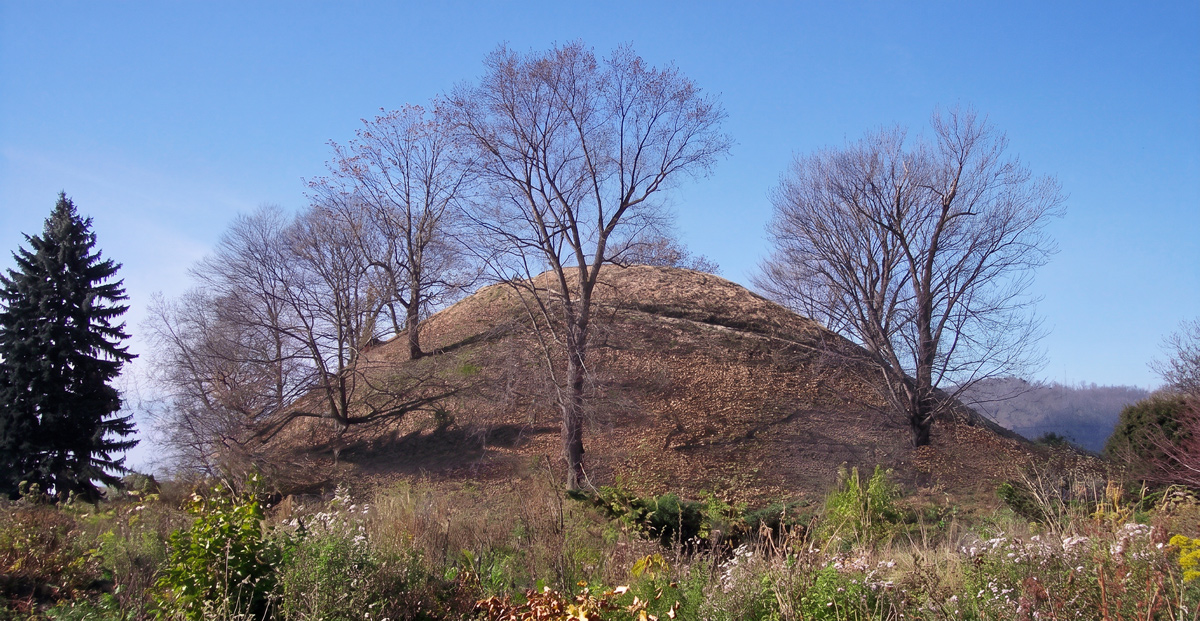
Generated from the original photo © 2006 by Tim Kiser. Permission to use granted under the Creative Commons Attribution-ShareAlike 2.5 Generic (CC-BY-SA 2.5) license. View the original at commons.wikimedia.org/wiki/File:Grave_Creek_Mound.jpg.
Lewis visited the large mound (Grave Creek Mound) at present Moundsville, West Virginia on 10 September 1803.
Louisville Mounds
A little way south of the Court House and just back of the town is a very large Indian mound. It is by appearance a hundred yards long and sixty yards wide and 20 or 30 feet high. This is much the largest I have seen; and there is a pond near each end of it where the earth was no doubt taken to raise the mound. It is still entire and unbroken.
I went to see the small mound I had noticed yesterday and then in the uper end of the town discovered three more large ones, two of them as large as the one I viewed yesterday but not quite so regular. One of them had a cellar dug for a house on top of it.
—Thomas Rodney, 15 and 17 October 1803[1]Dwight L. Smith and Ray Swick, ed., A Journey Through the West: Thomas Rodney’s 1803 Journal from Delaware to the Mississippi Territory (Athens: Ohio University Press, 1997), 121, 123.
Earlier Observations
In 1785, Samuel Holden Parsons came upon the ancient fortifications at present Marietta, Ohio. In a letter to Ezra Stiles—which was forwarded to Thomas Jefferson in Paris—he speculates on the site’s builders:
Middletown 27th April AD1786
Sir [Ezra Stiles]
The numerous mounds of Earth erected in conical forms, to the height of 70 or 80 F., containing the bones of the Dead, are proofs of this Country’s having been peopled heretofore by those who had some knowledge of the Arts; and the trees grown up in those fortresses are of a size which leaves little room to doubt that the works were abandoned long before this country was discovered by the Europeans. The present Inhabitants having no knowledge of the Arts or tradition respecting the fortifications leaves a doubt whether the present are the Immediate descendants of the former Inhabitants.
Sam H Parsons[2]Ezra Stiles to Thomas Jefferson, with Enclosure, 8 May 1786, Founders Online, National Archives, founders.archives.gov/documents/Jefferson/01-09-02-0401. [Original source: The Papers of Thomas … Continue reading
A General Calamity?
Washington Misisipi Territory May 14th 1804.
Dear President
I will now Take the Liberty of Mentioning What probably may be more Interesting to the Philosopher, the Historian, and the Antiquarian—It appears Evident to me that all the Western Country which is Watered by the Misisipi and its branches, has been Settled by a nation or People prior to the Present Indians—Their Tombs or Mounds, and Fortifications are Scattered over all the Country,
These are certainly the work of a People or Nation now Extinct, Who have probably been distroyed by some General calamity or perhaps by the Indians—Yet the Indians say they know not how those Mounds & Fortifications came to be in the Country—Indeed the many large animal bones found in Various parts of the Country, and which are now Extinct, Testify That some General Calamity has overwhelmed it, a long time ago;
Thomas Rodney[3]Founders Online, National Archives, founders.archives.gov/documents/Jefferson/01-43-02-0324. [Original source: The Papers of Thomas Jefferson, vol. 43, 11 March–30 June 1804, ed. James P. McClure … Continue reading
Indian Mound Profiles
Drawn by S. Eastman (1851)
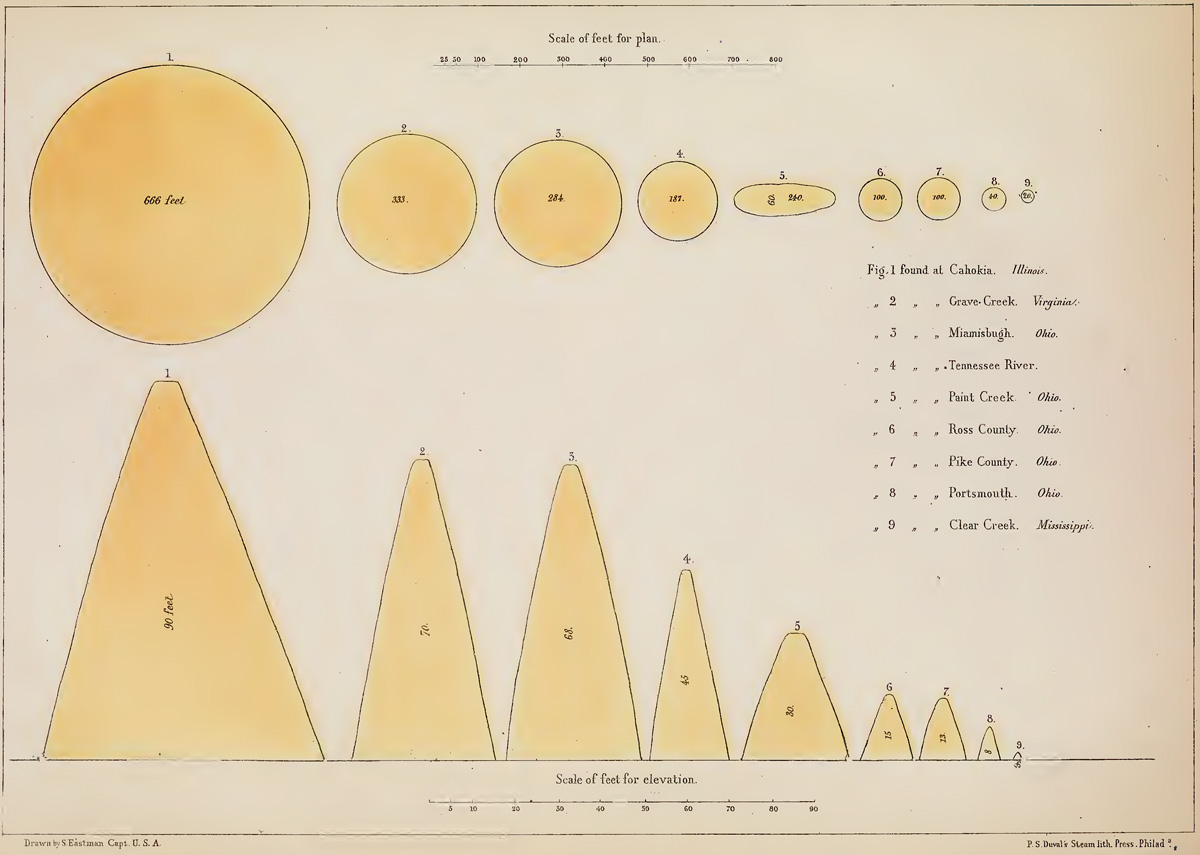
Schoolcraft, Historical and Statistical Information, 1851, plate 5.
Transcription:
| Location | Circumference (ft) | Elevation (ft) |
|---|---|---|
| Cahokia, Illinois | 666 | 90 |
| Grave Creek, Virginia | 333 | 70 |
| Miamisbugh, Ohio | 234 | 68 |
| Tennessee River | 181 | 45 |
| Paint Creek, Ohio | 60 x 240 | 30 |
| Ross County, Ohio | 100 | 15 |
| Pike County, Ohio | 100 | 13 |
| Portsmouth, Ohio | 40 | 8 |
| Clear Creek, Mississippi | 20 | [3?] |
Representative Griwswold’s Objection
The U.S. House of Representatives resumes the debate on whether to ratify the treaty authorizing the cession of Louisiana. Roger Griswold demands written documentation that the cession from Spain to France has occurred.
It appears in [the Treaty of St. Ildefonso] between Spain and France, Spain stipulated to cede to France, upon certain conditions, the province of Louisiana. The treaty between the United States and the French Government does not ascertain whether these terms have been complied with by France, or whether the cession has been actually made by Spain to France. All that appears is a promise made by Spain to cede. If the terms stipulated by France have not been complied with, and Spain has not delivered the province to France, then it results that France had no title, and of consequence that the United States has acquired no title from France.[5]Annals of Congress, 8th Cong., 1st sess., 385–86 at “A Century of Lawmaking,” Library of Congress, accessed 11 August 2022, … Continue reading
Experience the Lewis and Clark Trail
The Lewis and Clark Trail Experience—our sister site at lewisandclark.travel—connects the world to people and places on the Lewis and Clark Trail.
Plan a trip related to October 24, 1803:

Notes
| ↑1 | Dwight L. Smith and Ray Swick, ed., A Journey Through the West: Thomas Rodney’s 1803 Journal from Delaware to the Mississippi Territory (Athens: Ohio University Press, 1997), 121, 123. |
|---|---|
| ↑2 | Ezra Stiles to Thomas Jefferson, with Enclosure, 8 May 1786, Founders Online, National Archives, founders.archives.gov/documents/Jefferson/01-09-02-0401. [Original source: The Papers of Thomas Jefferson, vol. 9, 1 November 178–22 June 1786, ed. Julian P. Boyd (Princeton: Princeton University Press, 1954), 476–478.] |
| ↑3 | Founders Online, National Archives, founders.archives.gov/documents/Jefferson/01-43-02-0324. [Original source: The Papers of Thomas Jefferson, vol. 43, 11 March–30 June 1804, ed. James P. McClure (Princeton: Princeton University Press, 2017), 428–435.] |
| ↑4 | Henry R. Schoolcraft, Historical and Statistical Information Respecting the History, Condition and Prospects of the Indian Tribes of the United States (Philadelphia: Lippincott, Grambo & Company, 1851), vol.1, plate 5. |
| ↑5 | Annals of Congress, 8th Cong., 1st sess., 385–86 at “A Century of Lawmaking,” Library of Congress, accessed 11 August 2022, https://memory.loc.gov/cgi-bin/ampage?collId=llac&fileName=013/llac013.db&recNum=190. |