On or near this date, the expedition continues down the Ohio—perhaps passing present Alton, Indiana.[1]No known record exists of expedition’s travel between Falls of the Ohio and Fort Massac. Using information from travelers of the period and Cramer’s 1802 river guide, The Navigator, one … Continue reading Here, Thomas Rodney finds the river challenging and often split into multiple channels of which none are good. In 1808, a settler tells Fortescue Cuming of treating the Miami People like dogs.
Ohio River from Buzzard Roost
Hoosier National Forest
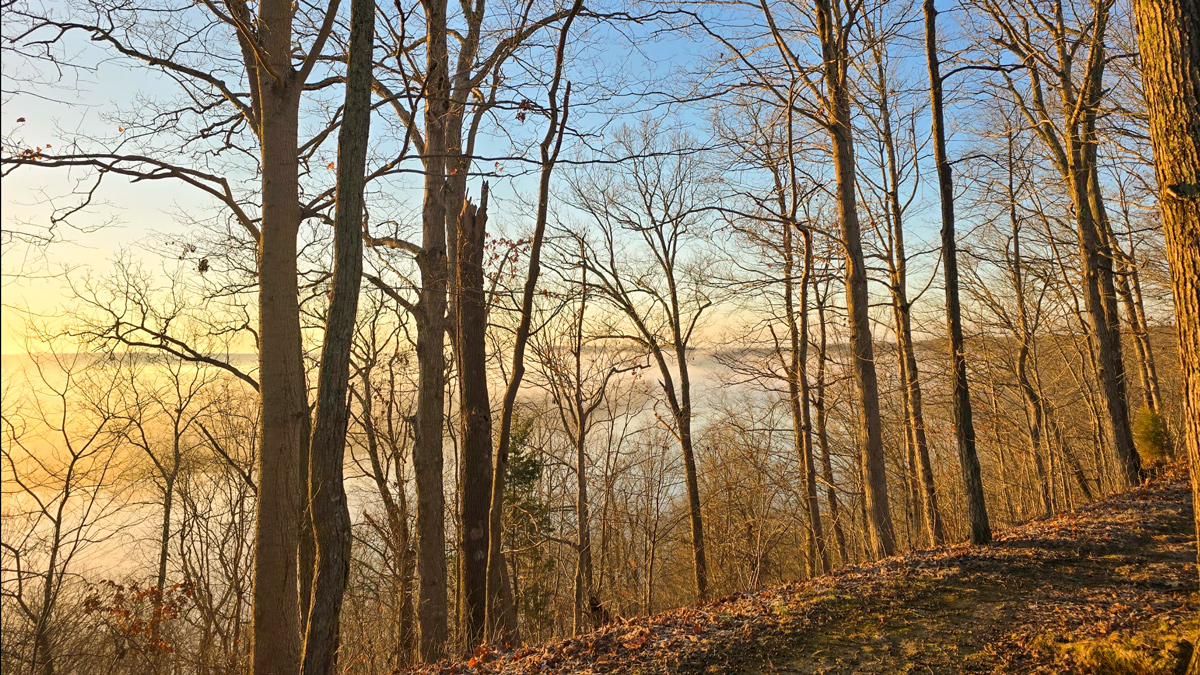
By Andy Mayfair, February 2025, shared at Google Maps.
Multiple Channels
[W]e passed the channel across at the lower end of the island before we saw it and kept on but touchd in passing the bar which spreads quite over the river below the island.
We have not before seen a bar spread more ginerally over the river of more difficult to discover, the way over there being several channels and none good
—Thomas Rodney, 22 October 1803[2]Dwight L. Smith and Ray Swick, ed., A Journey Through the West: Thomas Rodney’s 1803 Journal from Delaware to the Mississippi Territory (Athens: Ohio University Press, 1997), 130.
Indian-Settler Relations
Near the mouth of the Blue River in 1808, Fortescue Cuming recorded the following as told by a local resident:
He told us that a small tribe of Miami Indians were encamped on Oil creek about two miles distant. On asking if they were troublesome, he replied with much sang froid, still splitting his log, “We never permit them to be troublesome, for if any of them displease us, we take them out of doors and kick them a little, for they are like dogs, and so will love you the better for it.” He informed us, that they frequently get the Indians together, take their guns, knives and tomahawks from them, then treat them with whiskey until they are drunk, when they set them by the ears, to have the pleasure of seeing them fight . . . .
—Fortescue Cuming, 13 May 1808[3]Fortescue Cuming, Sketches of a Tour to the Western Country: Through the States of Ohio and Kentucky, a voyage down the Ohio and Mississippi rivers, and a trip through the Mississippi territory, and … Continue reading
During the Indian removal era, many of the Miami were relocated west of the Mississippi becoming the Miami Tribe of Oklahoma. Those remaining in Indiana became the Miami Nation of Indiana.[4]See “Miami Nation of Indiana”, en.wikipedia.org/wiki/Miami_Nation_of_Indiana and “Miami Tribe of Oklahoma”, en.wikipedia.org/wiki/Miami_Tribe_of_Oklahoma.
Hazard Mitigation
Ohio River Navigation Plan and Profile (1979)
U. S. Army Engineering Division
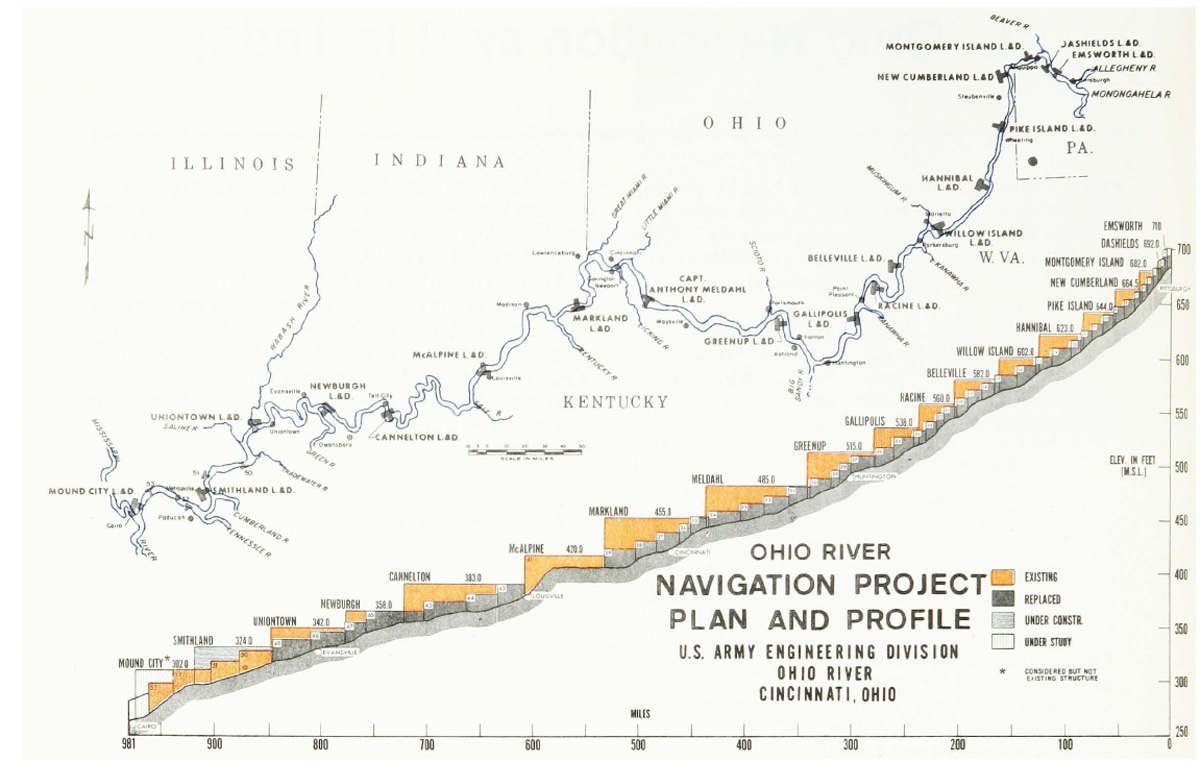
Ohio River Navigation, 1979.
Most of the Ohio River hazards were mitigated early in the 20th-century through engineering. By 1929, the entire river was slackwater, an accomplishment noted in this celebration program:
The Dream of Half a Century has been realized. The Ohio River has been completely canalized and periodical interruptions to navigation because of low water are of the past.
In its natural state it was one of the great rivers of the world and the chief factor in the development of the Middle-West, playing also an important part in the migration of pioneers to lands beyond.[5]Official Program and Complete History, Ohio River Pageant and Dedication, October 19th–25th, 1929, in Ohio River Navigation: Past, Present, Future (U.S. Army Corps of Engineers, Ohio River … Continue reading
Experience the Lewis and Clark Trail
The Lewis and Clark Trail Experience—our sister site at lewisandclark.travel—connects the world to people and places on the Lewis and Clark Trail.
Plan a trip related to October 29, 1803:

Notes
| ↑1 | No known record exists of expedition’s travel between Falls of the Ohio and Fort Massac. Using information from travelers of the period and Cramer’s 1802 river guide, The Navigator, one conjecture is that the expedition was in the vicinity of Stephensport, Kentucky on this date. |
|---|---|
| ↑2 | Dwight L. Smith and Ray Swick, ed., A Journey Through the West: Thomas Rodney’s 1803 Journal from Delaware to the Mississippi Territory (Athens: Ohio University Press, 1997), 130. |
| ↑3 | Fortescue Cuming, Sketches of a Tour to the Western Country: Through the States of Ohio and Kentucky, a voyage down the Ohio and Mississippi rivers, and a trip through the Mississippi territory, and part of West Florida, commenced at Philadelphia in the winter of 1807 . . . (Pittsburgh: Cramer, Spear, & Eichbaum, 1810), 238-39. |
| ↑4 | See “Miami Nation of Indiana”, en.wikipedia.org/wiki/Miami_Nation_of_Indiana and “Miami Tribe of Oklahoma”, en.wikipedia.org/wiki/Miami_Tribe_of_Oklahoma. |
| ↑5 | Official Program and Complete History, Ohio River Pageant and Dedication, October 19th–25th, 1929, in Ohio River Navigation: Past, Present, Future (U.S. Army Corps of Engineers, Ohio River Division, 1979), 1. |