On or near this day, the expedition passes Hanging Rock, an old Ohio River landmark near present Rockport, Indiana. Also near this date, Clark‘s contraction of the muscular system was removed by the doctoring of Meriwether Lewis.
Pushing the Boat
Louisville to Fort Massac. . . we turned into a narrow channel between the lower bar and the NW shore and preferred it; and it was very good till we got half way and then we found a riffle quite across it that we could not float over. We all turnd out and in a manner lifted the boat over . . . .
—Thomas Rodney, 24 October 1803[1]Dwight L. Smith and Ray Swick, ed., A Journey Through the West: Thomas Rodney’s 1803 Journal from Delaware to the Mississippi Territory (Athens: Ohio University Press, 1997), 134.
Hanging Rock
Rodney’s Small Remarkable Mountain?
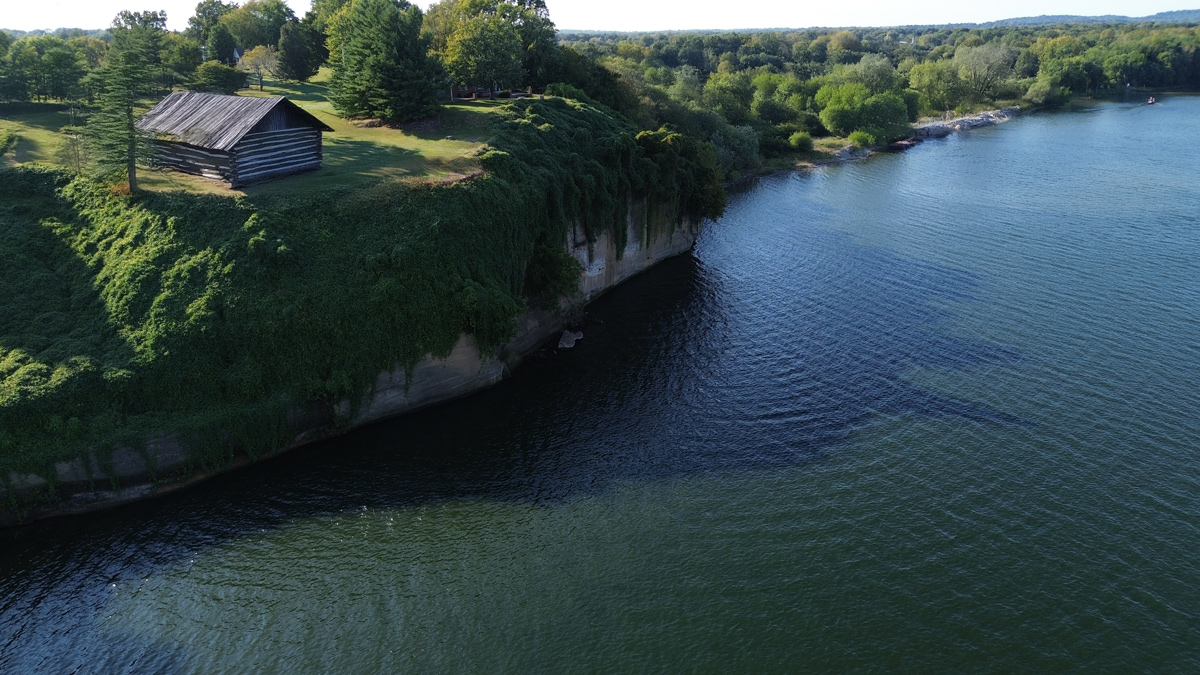
Image derived from an original photo © 2024 by Richard Hunt. Used by permission. Today, modern houses sit atop this rock.
A[t] the point on the NW shore where this bar ends there is a small remarkable rocky mountain in the midst of the plain country. A large round stone part of the mountain has been broke off by its own weight by the rock below dissolving or moultering away, and in its fall has made a great road in the side of the rock that the mountain is composed of, which is to be seen 8 or ten miles before you git to it. The lump of rock aforesaid that rolld down persued it course to the verge of the river where it stoped and appears as you approach it like a haystack.
—Thomas Rodney, 24 October 1803[2]Ibid.
Rodney’s hanging rock that may have broken from this cliff, no longer exists. If Lewis or Clark had any thoughts about this small abutment, they did not—as far as we know—record them in writing.
Clark’s Contraction
Writing to his brother Jonathan on 16 December 1803, William Clark reports that he became ill sometime after leaving Louisville:
Opposit the Mouth of the Missouri
December 16th 1803Dear Brother:
a fiew days after I parted with you on the river bank, I was taken Violent ill by a Contraction of the muskelur Sistem, this indisposition Continued Several days and was ultimately removed by the exertions & Close attention of Capt. Lewis.
Brother
Wm Clark[3]James J. Holmberg, ed. Dear Brother: Letters of William Clark to Jonathan Clark (New Haven: Yale University Press, 2002), 60.
Experience the Lewis and Clark Trail
The Lewis and Clark Trail Experience—our sister site at lewisandclark.travel—connects the world to people and places on the Lewis and Clark Trail.
Plan a trip related to October 31, 1803:

Notes
| ↑1 | Dwight L. Smith and Ray Swick, ed., A Journey Through the West: Thomas Rodney’s 1803 Journal from Delaware to the Mississippi Territory (Athens: Ohio University Press, 1997), 134. |
|---|---|
| ↑2 | Ibid. |
| ↑3 | James J. Holmberg, ed. Dear Brother: Letters of William Clark to Jonathan Clark (New Haven: Yale University Press, 2002), 60. |