Today is likely Lewis‘s first day at Big Bone Lick where many large mammals sank into its marshes and died. The diggings have been described by many including Nicholas Cresswell in 1775, Thomas Rodney on October 10, 1803, and William Clark on November 10, 1807.[1]In his letter of 3 October, Lewis stated he would leave Cincinnati early the following morning. He likely arrived at Big Bone Lick on the evening of 4 October.
In Washington City, Henry Dearborn of the War Department asks General Wilkinson to have the Army ready to respond if Spain opposes the transfer of Louisiana to the United States.
Big Bone Lick Creek
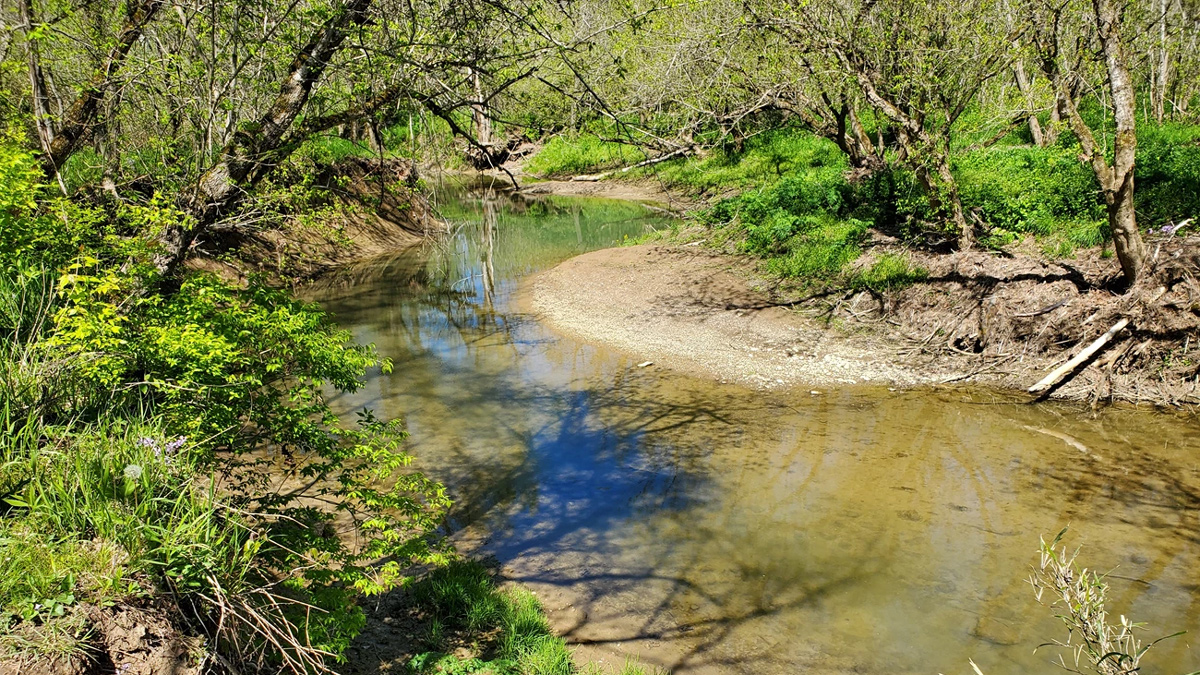
Photo by Vincent Santucci of the U.S. National Park Service.
By licks are meant, in the western country, springy places, naturally affording salt, in search of which, the various species of herbivorous animals, both wild and domestic, resort to them in great numbers. At Big-bone Lick, the salt is deposited from numerous springs, rising through the soil over a surface of several acres. There are likewise several streams of fresh water, that enter the valley from different sides; and these uniting, form a small river, which, taking a southerly course, discharges itself at the distance of twelve miles, into the Ohio.[2]William Cooper, “Notices of Big-Bone Lick”, Monthly American Journal of Geology and Natural Science 1 no. 11 (1831): 158, archive.org/details/monthlyamericanj11831phil, accessed 3 … Continue reading
Creswell’s First Day (1775)
Where the bones are found is a large muddy pond, a little more than knee deep with a Salt spring in it which I suppose preserves the bones sound.
Found several bones of a prodigious size, I take them to be Elephants, for we found a part of a tusk, about two foot long, Ivory to all appearance, but by length of time had grown yellow and very soft. All of us stripped and went into the pond to grabble for teeth and found several.
Saw some Buffaloes but killed none. Several Indian paintings on the trees.[3]Nicholas Cresswell, The Journal of Nicholas Cresswell 1774–1777, edited by Lincoln MacVeagh (New York: The Dial Press, 1924), 58, originally in one paragraph.
Rodney’s Impressions (1803)
The main spring at the uper salt works boiled up to the sufface of the ground and fell into the salt wells they had dug around it, which were only 4 or 5 feet deep at the lower works. There was several large wells 10 or 12 feet deep.
—Thomas Rodney, 10 October 1803[4]Dwight L. Smith and Ray Swick, ed., A Journey Through the West: Thomas Rodney’s 1803 Journal from Delaware to the Mississippi Territory (Athens: Ohio University Press, 1997), 113.
Brown’s Technique (1806)
Washington M[ississippi]. Territory Augt. 24th 1806
Dear Sir [Thomas Jefferson]
The bones are found in a marsh of about half an acre in extent & are buried in the mud from four to ten feet deep—The mud is soft & they can be felt by running a pole down into it & are easily raised.
Sam Brown[5]Samuel Brown to Thomas Jefferson, Founders Online, National Archives, founders.archives.gov/documents/Jefferson/99-01-02-4195, accessed 3 September 2026.
Clark’s Experience (1807)
Louis Ville Kentucky Novr. 10th. 1807.
Sir [Thomas Jefferson]
This Lick is in a Valley serounded with hills, the atmosphere Cold and damp. I had for the first time in my life, the Rheumatism in My wrists, sholders, hips and knees dureing the time I remained under the influence of the Vapour arriseing from this Lick, and several of the men who’ worked in the water were slightly attacked with a chill & fever.—
Wm. Clark.[6]William Clark to Thomas Jefferson, Founders Online, National Archives, founders.archives.gov/documents/Jefferson/99-01-02-6754, accessed 3 September 2026.
Resisting Spanish Opposition
In response to the King of Spain’s objections to the transfer of Louisiana to the United States of America—see October 4, 1803, plans are made for a potential military response if needed.
War Department 5 Oct. 03
Jas. Wilkinson
SIR The Government of Spain having discovered some disposition to oppose our taking possession of Louisiana, conformably to our Treaty with France, . . . it is thought advisable to be in some measure prepared for such an Event. It is therefore the wish of the Prest. of the U. S. that you wold, in concert with Govr. Claiborne, take the necessary measures for having Boats, provisions, field Pieces &c &c in readiness; not only for regular Troops in the Terry. but also for at least 500 of the best Militia (who if necessary should be engaged for 3 Months) and for such Boatmen & Sailors, as may be engaged at N. Orleans . . . .
Orders will be sent to Massac & Chickesaw Bluffs for those two Companies to be in readiness to move down, at the shortest notice—[7]Henry Dearborn, Secretary of War to James Wilkinson, U.S. Army Commander General, Washington, DC, 5 October 1803 in Clarence E. Carter, The Territorial Papers of the United States (Washington, DC: … Continue reading
[Henry Dearborn]
Experience the Lewis and Clark Trail
The Lewis and Clark Trail Experience—our sister site at lewisandclark.travel—connects the world to people and places on the Lewis and Clark Trail.
Plan a trip related to October 5, 1803:
Notes
| ↑1 | In his letter of 3 October, Lewis stated he would leave Cincinnati early the following morning. He likely arrived at Big Bone Lick on the evening of 4 October. |
|---|---|
| ↑2 | William Cooper, “Notices of Big-Bone Lick”, Monthly American Journal of Geology and Natural Science 1 no. 11 (1831): 158, archive.org/details/monthlyamericanj11831phil, accessed 3 September 2026. |
| ↑3 | Nicholas Cresswell, The Journal of Nicholas Cresswell 1774–1777, edited by Lincoln MacVeagh (New York: The Dial Press, 1924), 58, originally in one paragraph. |
| ↑4 | Dwight L. Smith and Ray Swick, ed., A Journey Through the West: Thomas Rodney’s 1803 Journal from Delaware to the Mississippi Territory (Athens: Ohio University Press, 1997), 113. |
| ↑5 | Samuel Brown to Thomas Jefferson, Founders Online, National Archives, founders.archives.gov/documents/Jefferson/99-01-02-4195, accessed 3 September 2026. |
| ↑6 | William Clark to Thomas Jefferson, Founders Online, National Archives, founders.archives.gov/documents/Jefferson/99-01-02-6754, accessed 3 September 2026. |
| ↑7 | Henry Dearborn, Secretary of War to James Wilkinson, U.S. Army Commander General, Washington, DC, 5 October 1803 in Clarence E. Carter, The Territorial Papers of the United States (Washington, DC: United States Government Printing Office, 1948), 9:71, digitized by Google books. |