At Big Bone Lick, Lewis collects the largest fossil specimens leaving little for Thomas Rodney. Unfortunately, the collection would later be lost in transit to Washington City and Philadelphia. Browse Trist and Thomas Rodney provide two slightly different accounts of the incident.
Mastodon Herd
Charles R. Knight (1874–1953)
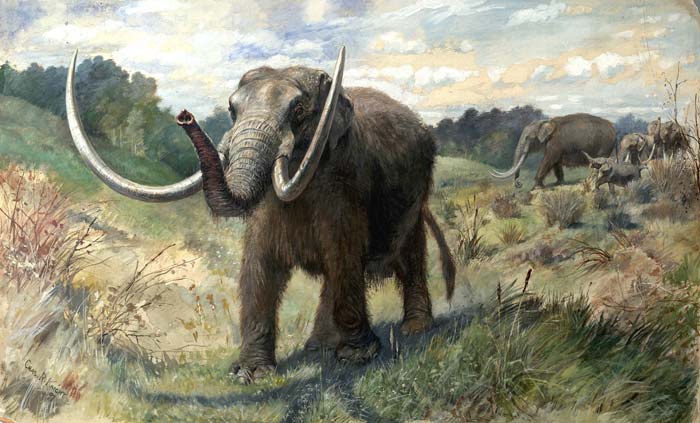
Image is in the public domain.
Nobody expected to find living Mastodons, musk oxen, stag moose, or giant ground sloths at Big Bone Lick. One of the scientific contributions of the Lewis and Clark Expedition was to help confirm that these large fauna were indeed extinct. See Thoughts on Extinction.
Lewis Takes the Best
When we came to the lick, I measured several of the bones as follows: the face or forhead of a head bone three feet wide across the widest part which near the uper part of the face or forhead, a thigh bone 26 inches long and very thick, one side of a gaw bone thirty inches long, and the socket of a shoulder blade six inches wide. These are the largest bones now left at the licks.
Captain Lewes [Lewis] had got the long tusk lately found and one or another has carried of[f] the larger bones; but the situation and circumstances of these licks shew that they have been long frequented and much more formerly than latterly. [I also got a small piece that had scaled off from the great tusk that Lewies had taken . . . .]
—Thomas Rodney, 10 October 1803[1]Dwight L. Smith and Ray Swick, ed., A Journey Through the West: Thomas Rodney’s 1803 Journal from Delaware to the Mississippi Territory (Athens: Ohio University Press, 1997), 111–112.
A Most Mortifying Event
New Orleans 6 March 1804
Dear Sir [Thomas Jefferson],
Captain Lewis by letter from [Fort] Massac under date 10 November last, informed me, that he had address’d to my care at Fort Adams three Boxes, requesting two of them to be forwarded you, and the other to Mr Peale in Philadelphia . . . . Unfortunately however the owner of the Boat in which they were sent, on his arrival at Natchez, was put in prison, and in consequence of his giving no information to any person relative to the Boxes, two of them were sunk in the river, & the third broken open, & the Contents stolen or destroyed. This to me is a most mortifying event, not only from the disappointment to Captain Lewis, but also that notwithstanding every precaution on my part for their safe conveyance, I have been prevented gratifying you with these curiosities, which in all probability would have thrown some additional light upon the natural history of our Country . . . . I have requested however that no exertions may be spared to recover them if possible.
Hore Browse Trist[2]Hore Browse Trist to Thomas Jefferson, Founders Online, National Archives, founders.archives.gov/documents/Jefferson/01-42-02-0520 accessed 3 September 2026. [Original source: The Papers of Thomas … Continue reading
Thomas Rodney’s Version
Misisipi Territory, Natchez Feby. 7 1806.
Dr. Sir [Charles Willson Peale],
the bones Collected by Captn. Lewis, came down to Natchez, – Unfortunately however the boat that brought them sunk by the shore, and only one box was saved and Thrown out on the shore – In this was a Jaw bone, or part of a Jaw bone, of the Wild Boar; and a grinder . . . . one bunch of the roots, with part of the grinder, that broke off with it, weighed five pounds – this was broken off by the Tennessee Militia Men in Natchez – the box being thrown out and no one to take care of it, great part of the bones were taken away, tho intended by Captn. Lewis for the President of the United States –
[Thomas Rodney][4]Thomas Rodney to Charles Willson Peale, 7 February 1806, American Philosophical Society, Peale-Sellers Family Collection, 1686–1963, Mss.B.P31, diglib.amphilsoc.org/islandora/object/text%3A257910 … Continue reading
Experience the Lewis and Clark Trail
The Lewis and Clark Trail Experience—our sister site at lewisandclark.travel—connects the world to people and places on the Lewis and Clark Trail.
Plan a trip related to October 6, 1803:
Notes
| ↑1 | Dwight L. Smith and Ray Swick, ed., A Journey Through the West: Thomas Rodney’s 1803 Journal from Delaware to the Mississippi Territory (Athens: Ohio University Press, 1997), 111–112. |
|---|---|
| ↑2 | Hore Browse Trist to Thomas Jefferson, Founders Online, National Archives, founders.archives.gov/documents/Jefferson/01-42-02-0520 accessed 3 September 2026. [Original source: The Papers of Thomas Jefferson, vol. 42, 16 November 1803–10 March 1804, ed. James P. McClure (Princeton: Princeton University Press, 2016), 589.] |
| ↑3 | David Thorson, 27 July 2020, “Hore Browse Trist, Sr.”, The Jefferson Monticello www.monticello.org/encyclopedia/hore-browse-trist-sr/, accessed 4 September 2026. |
| ↑4 | Thomas Rodney to Charles Willson Peale, 7 February 1806, American Philosophical Society, Peale-Sellers Family Collection, 1686–1963, Mss.B.P31, diglib.amphilsoc.org/islandora/object/text%3A257910 accessed 3 September 2026. |