Because the fossils collected on this day by Meriwether Lewis at Big Bone Lick never arrived in Washington City and Philadelphia, President Jefferson would ask William Clark to collect specimens. In September 1807, William—and his brother George—”accomplished the business committed to him with great promptitude”.
Clark’s Diggings
Clark’s Specimens
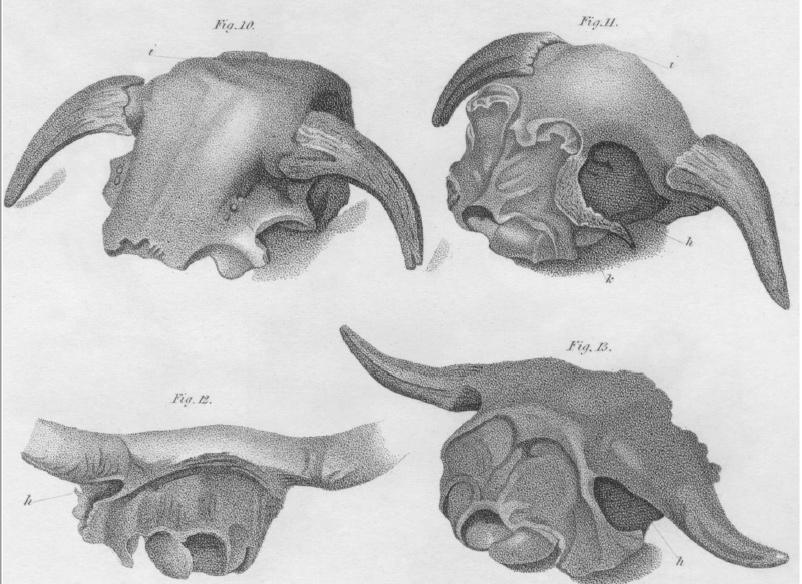
Caspar Wistar, Account of Heads, Plate XI.
Top row: specimens collected by William Clark at Big Bone Lick in 1807.
Bottom row: ox and buffalo used for comparison.
Camp! Big Bone Lick September 20th. 1807.
Sir [Thomas Jefferson]
I have been employed two weeks at this place with ten hands Searching for the bones of the Mammoth &c. without meeting with as much suckcess as I expected. This Lick has been pillaged so frequently, that but fiew valuable bones are to be found entire.—I have found part of Several heads of the Mammoth, the most of them so decayed, that when the soft mud was taken from them and the air admited, they Crumbled and fell to pieces.
My Brother George is with me and requests you to accept of the assurence of his most Sincear respect.
With every Sentiment of the highest respect and veneration I have the honer to be Your [most humble servant]
Wm Clark[1]William Clark to Thomas Jefferson, Founders Online, National Archives, founders.archives.gov/documents/Jefferson/99-01-02-6406, accessed 3 September 2026.
Jefferson to Wistar
Washington Dec. 19. 07
Dear Sir [Caspar Wistar]
I have lately recieved a letter from Genl. Clarke. he has employed ten labourers, several weeks at the Big-bone Lick, & has shipped the result, in 3. large boxes, down the Ohio, via New-Orleans for this place, where they are daily expected. he has sent
1. of the Mammoth, as he calls it, frontals, jawbones, tusks, teeth, ribs, a thigh & a leg, and some bones of the paw.
2. of what he calls the Elephant, a jawbone, tusks, teeth, ribs.
3. of something of the Buffalo species a head: & some other bones unknown.
. . . . .
there is a tusk & a femur which Genl. Clarke procured particularly at my request for a special kind of Cabinet I have at Monticello. but the great mass of the collection are mere duplicates of what you possess at Philadelphia, of which I would wish to make a donation to the National institute of France
. . . . .
I salute you with friendship & respect.
Th: Jefferson[2]Thomas Jefferson to Caspar Wistar, Founders Online, National Archives, founders.archives.gov/documents/Jefferson/99-01-02-7035, accessed 3 September 2026.
Clark’s Ancient Buffalo Bones
In an 1818 paper addressed to the American Philosophical Society, Caspar Wistar discusses two skull types from specimens collected by the Clark brothers in the fall of 1807:
The two heads which are the subjects of the following observations, were selected from a large number of bones presented to the society by our much venerated President Jefferson. Being satisfied that the morass near the falls of Ohio, called the Big Bone Lick, still contained many animal remains which were worthy of attention, he engaged General Wm. Clarke, who is so honourably known to the world by his Journey to the Pacific Ocean, to explore it, and furnished him with all the means necessary for so expensive an undertaking.
Gen. Clarke accomplished the business committed to him with great promptitude, and procured several large boxes of bones.—
By comparing the Big Bone Lick specimens collected by Clark, (see figure) with that of the common ox, Wistar concluded, “Was not this animal nearly allied to the bison?”[3]Mr. Jefferson, and Caspar Wistar. “An Account of Two Heads Found in the Morass, Called the Big Bone Lick, and Presented to the Society, by Mr. Jefferson.” Transactions of the American … Continue reading
Today, we know that the large fuana found at Big Bone Lick are “the extinct bison Bison antiquus, the musk ox Bootherium bombifrons, the stag moose Cervalces scotti, and the ground sloth (Jefferson’s Megalonyx) Paramylodon harlani.”[4]Justin Tweet, Spring 2025, “Paleontology and Geology of Big Bone Lick National Natural Landmark”, Paleo, U.S. National Park Service, … Continue reading
Experience the Lewis and Clark Trail
The Lewis and Clark Trail Experience—our sister site at lewisandclark.travel—connects the world to people and places on the Lewis and Clark Trail.
Plan a trip related to October 7, 1803:
Notes
| ↑1 | William Clark to Thomas Jefferson, Founders Online, National Archives, founders.archives.gov/documents/Jefferson/99-01-02-6406, accessed 3 September 2026. |
|---|---|
| ↑2 | Thomas Jefferson to Caspar Wistar, Founders Online, National Archives, founders.archives.gov/documents/Jefferson/99-01-02-7035, accessed 3 September 2026. |
| ↑3 | Mr. Jefferson, and Caspar Wistar. “An Account of Two Heads Found in the Morass, Called the Big Bone Lick, and Presented to the Society, by Mr. Jefferson.” Transactions of the American Philosophical Society 1 (1818): 375-80. doi:10.2307/1004925. |
| ↑4 | Justin Tweet, Spring 2025, “Paleontology and Geology of Big Bone Lick National Natural Landmark”, Paleo, U.S. National Park Service, www.nps.gov/articles/paleontology-and-geology-of-big-bone-lick-national-natural-landmark.htm, accessed 4 September 2026. |