On or near this date, Lewis returns to the Ohio River with fossils from Big Bone Lick. His journal contains a gap for this date, but several others express their thoughts about the mammals once living at the diggings.
Ohio River near Petersburg
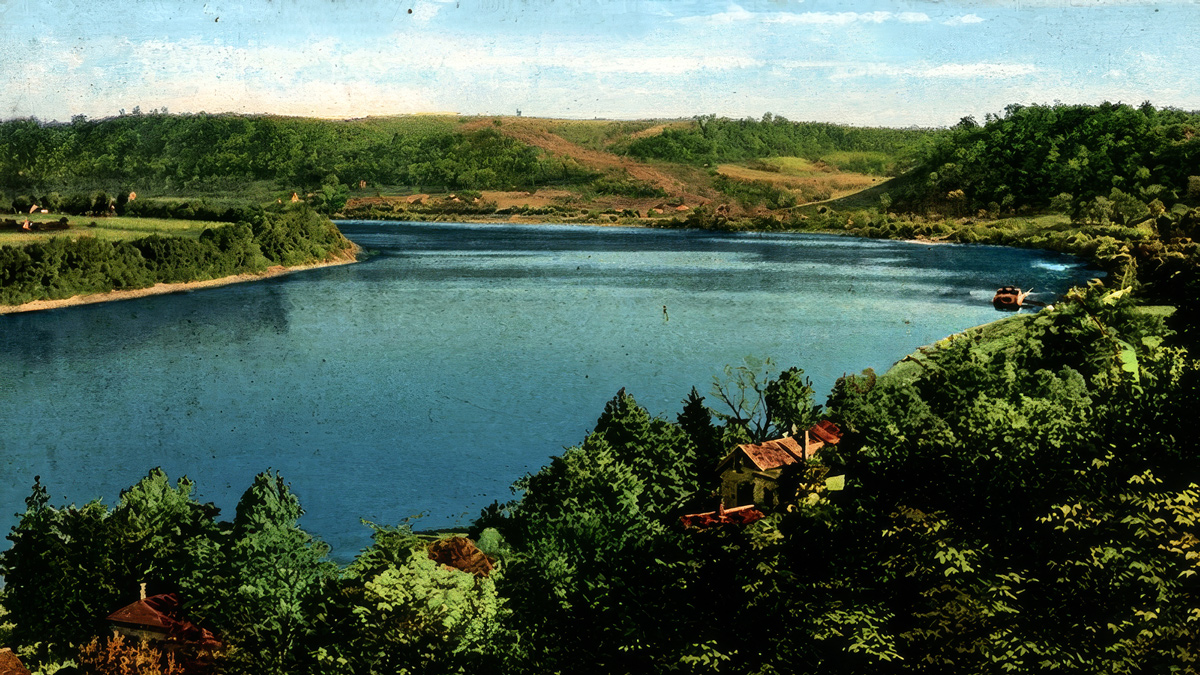
Generated from the original, date and photographer unknown, courtesy www.nkyviews.com.
Native American Thoughts (1775)
Thomas Cresswell seemed very confused by the size of the mammal fossils found here:
What sort of animals these were is not clearly known. All the traditionary accounts by the Indians is that they were White Buffaloes that killed themselves by drinking salt water. It appears to me from the shape of their teeth that they were Grasseaters. There neither is or ever was any Elephants in North or South America, that I can learn, or any quadruped one tenth part as large as these was, if one may be allowed to judge from the appearance of these bones, which must have been considerably larger than they are now.[1]Nicholas Cresswell, The Journal of Nicholas Cresswell 1774–1777, edited by Lincoln Macveagh (New York: The Dial Press, 1924), 58.
Cramer’s Thoughts (1802)
In the river guidebook that Lewis had with him, Zadok Cramer relays a common opinion of the day:
This is the place where so many of those remarkable large bones have been found, that have attracted the attention of the curious, and which must have belonged to some monstrous animal, whose race is not tho’t to be entirely extinct.
—Zadok Cramer [2]Zadok Cramer, The Ohio and Mississippi Navigator: Containing Directions for Navigating the Monongahela, Allegheny, Ohio and Mississippi Rivers . . . (Pittsburgh: Zadok Cramer, Bookseller & … Continue reading
Rodney’s Thoughts (1803)
After departing Big Bone Lick, Thomas Rodney examined the fossils he had seen there, and speculated that they may not be the actual bones of animals, but nature’s recreation, and exaggeration, of decomposed animals.
On the Ohio, October 11th 1803, Tuesday.
I imbrace a moment of lezure to make a few observation on the bones of the salt lick. I have in the course of my enquieries into the opperations of nature observed that she produces boney, shelly, and other substance in imitation of those that belong to animal and vegetable nature . . . .
These being reduced to simple elements again by time in great abundance in time by the force of nature might be stured up to motion again and produce massy forms of bone beyond the size of any animals existing or that ever did exist . . . .
Another thing is observable. These fosil teeth are of a form different from those of all known animals.
—Thomas Rodney[3]Dwight L. Smith and Ray Swick, ed., A Journey Through the West: Thomas Rodney’s 1803 Journal from Delaware to the Mississippi Territory (Athens: Ohio University Press, 1997), 113–114.
Clark’s Thoughts (1807)
After supervising an extensive dig at Big Bone Lick, William Clark thinks the animals found here are now extinct:
Louis Ville Kentucky Novr. 10th. 1807.
Sir [Thomas Jefferson]
I have made a serch in the Encyclopadea (which is the only treatise I have on Zoology) particularly under the genus Bos and Capra, for a discription of those smaller animals, but it has only served to convince me, that the Animals to whom belonged the smaller bones, found at the Big bone lick, are entirely unknown, and that their race, like their great cotemporary the Mammoth, is quit extinct; however I hope the specimins will give the Society an oppertunity of satisfactorily determining this point, as well as their Class and figure.
Wm. Clark.[4]William Clark to Thomas Jefferson, Founders Online, National Archives, founders.archives.gov/documents/Jefferson/99-01-02-6754, accessed 3 September 2026.
Experience the Lewis and Clark Trail
The Lewis and Clark Trail Experience—our sister site at lewisandclark.travel—connects the world to people and places on the Lewis and Clark Trail.
Plan a trip related to October 8, 1803:
Notes
| ↑1 | Nicholas Cresswell, The Journal of Nicholas Cresswell 1774–1777, edited by Lincoln Macveagh (New York: The Dial Press, 1924), 58. |
|---|---|
| ↑2 | Zadok Cramer, The Ohio and Mississippi Navigator: Containing Directions for Navigating the Monongahela, Allegheny, Ohio and Mississippi Rivers . . . (Pittsburgh: Zadok Cramer, Bookseller & Stationer, 1802), 35. |
| ↑3 | Dwight L. Smith and Ray Swick, ed., A Journey Through the West: Thomas Rodney’s 1803 Journal from Delaware to the Mississippi Territory (Athens: Ohio University Press, 1997), 113–114. |
| ↑4 | William Clark to Thomas Jefferson, Founders Online, National Archives, founders.archives.gov/documents/Jefferson/99-01-02-6754, accessed 3 September 2026. |